
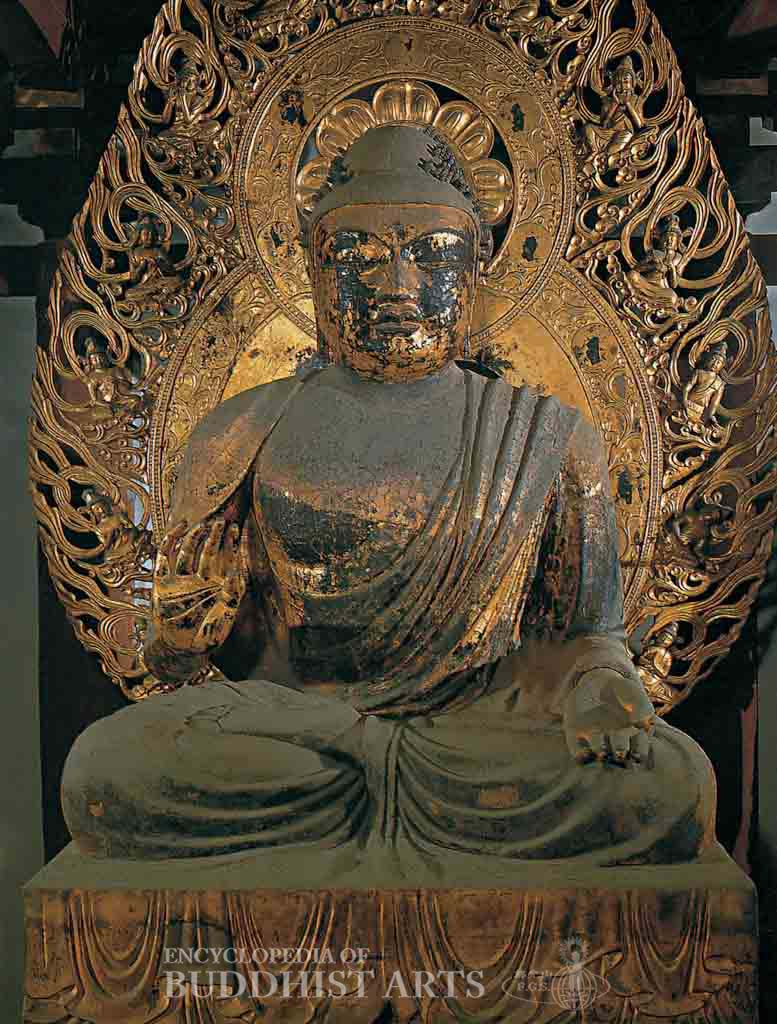
Taimadera Temple Golden Hall: Maitreya Buddha
Clay
Taimadera Temple Golden Hall: Maitreya Buddha
JAPAN, Nara, Katsuragi; Hakuho period
Taimadera Temple’s Maitreya Buddha, enshrined within the Golden Hall, is the oldest Japanese statue in existence. Thought to be the work of Korean artisans working in Japan when the temple was founded in 681, it was listed as a National Treasure in 1952.
The statue’s head is disproportionately larger, giving the figure a sense of reverence and power. Much of the curled hair has worn away, as has the urna, of which only a trace remains on the forehead. The brows arc over half closed eyelids, the nose is broad, and the pursed lips full. The Buddha sits in full lotus position wearing monastic robes, with his right hand in the abhaya (fearlessness) mudra and the left hand on his knee in varada (wish-granting) mudra. That the scene is of the future Buddha’s enlightenment is attested to by the fretted wooden mandorla about which heavenly musicians with trailing stoles salute and serenade his achievement. Within the mandorla are an interconnecting aureole and nimbus with foliate patterns around their outer rim. This construction and the statue’s restored arms appear to date from the middle of the Kamakura period (1185–1333).
For more details, go to the Encyclopedia of Buddhist Arts: Sculpture St-Z, page 1189.
Cite this article:
author = Hsingyun and Youheng and Lovelock, Yann and Chou, Yuan and Huntington, Susan and Edson, Gary and Neather, Robert,
booktitle = {Encyclopedia of Buddhist Arts: Sculpture St-Z},
pages = 1189,
title = {{Taimadera Temple Golden Hall: Maitreya Buddha}},
volume = 13,
year = {2016}}