
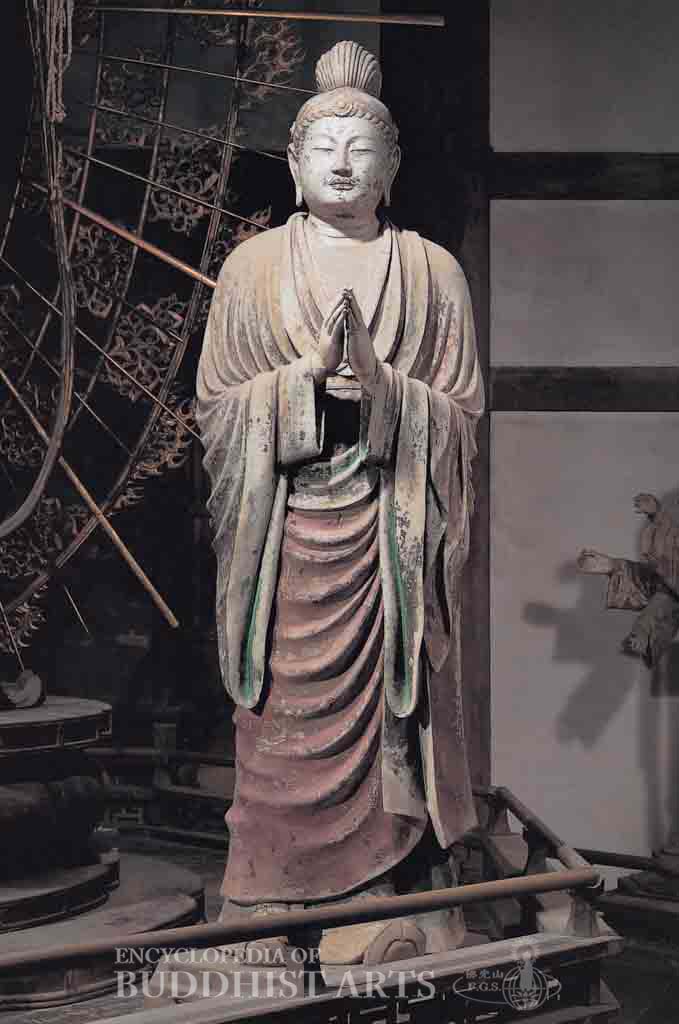
Todaiji Temple Lotus Hall: Suryaprabha and Candraprabha Bodhisattvas - Suryaprabha
Clay
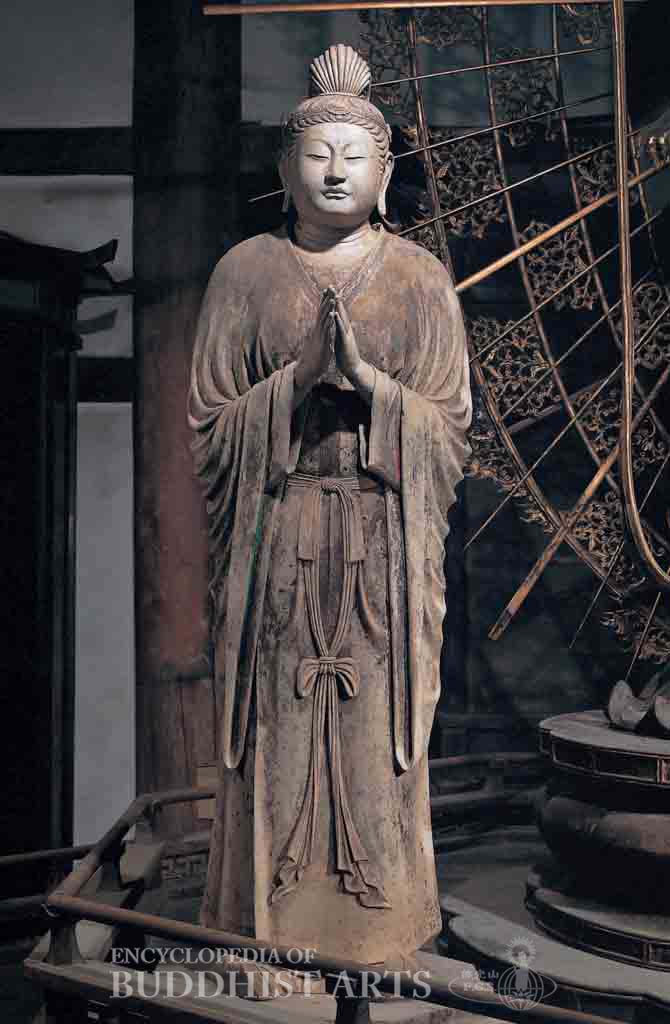
Todaiji Temple Lotus Hall: Suryaprabha and Candraprabha Bodhisattvas - Candraprabha
Todaiji Temple Lotus Hall: Suryaprabha and Candraprabha Bodhisattvas
JAPAN, Nara; Nara period
These Bodhisattvas flank the central Amoghapasa Avalokitesvara in the Lotus Hall. Compared to other statues in the Lotus Hall, these are smaller and different in style and material, and so are thought to have come from another temple. They are made from clay using the thick comb technique popular in the Nara period (710–794). The figures are made in a style that suggests Chinese influence. They were listed as a National Treasure in 1952.
Both Bodhisattvas have elaborately dressed hair, bound by a chrysanthemum fillet. Their almost identical faces are round and tranquil. They are simply dressed in wide-sleeved robes reaching to the feet, with their hands in anjali (reverence) mudra. Suryaprabha Bodhisattva wears an over-robe with strongly ridged folds rippling outward from the upper body and downward below the waist. A chrysanthemum-shaped leather belt with long ties falling in decorative bows to shin level secures Candraprabha Bodhisattva’s robe at the waist. Some of the paint and fine gold leaf patterns still remain. The fair complexion of the face is produced by mixing mica polish into the plaster, showing the mastery of color modulation techniques in Nara sculpture.
For more details, go to the Encyclopedia of Buddhist Arts: Sculpture St-Z, page 1223.
Cite this article:
author = Hsingyun and Youheng and Lovelock, Yann and Chou, Yuan and Huntington, Susan and Edson, Gary and Neather, Robert,
booktitle = {Encyclopedia of Buddhist Arts: Sculpture St-Z},
pages = 1223,
title = {{Todaiji Temple Lotus Hall: Suryaprabha and Candraprabha Bodhisattvas}},
volume = 13,
year = {2016}}