
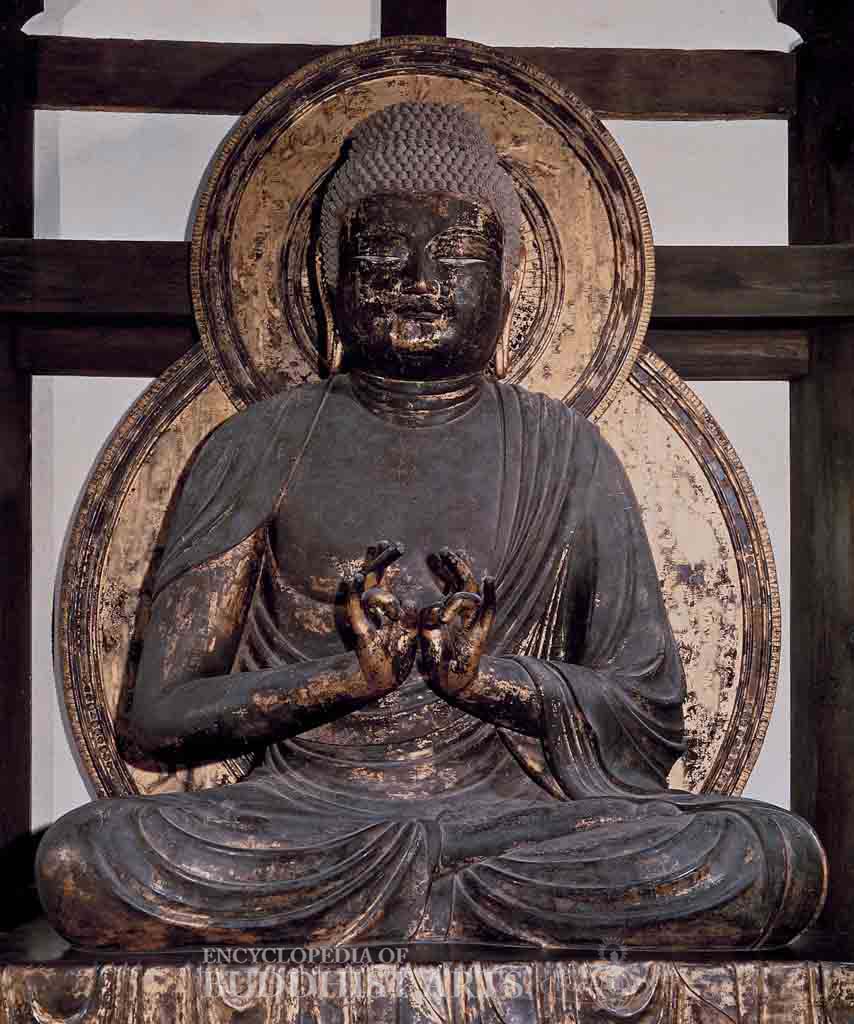
Koryuji Temple Lecture Hall: Amitabha Buddha
Wood
Koryuji Temple Lecture Hall: Amitabha Buddha
JAPAN, Kyoto; Heian period
According to temple records, this statue is thought to have been commissioned by a concubine of Emperor Junna (reigned 823–833) in 840 in memory of the deceased emperor. The sculpture is one of the few extant examples that inherits the conservative Nara (710–794) style but also shows characteristics from the early Heian period (794–1185). It was listed as a National Treasure in 1952.
The sculptor employed the wood-core dry lacquer technique with a gold leaf finish. The figure is depicted sitting in full lotus position dressed in monastic robes. Both hands are placed together facing forward in the lowest grade of the lowest class mudra, representing the Buddha’s teaching in the Western Pure Land. The ridge-like creases of the robes are cut in clean strokes. The intersecting, circular nimbus and aureole are thought to be later additions, as are the urna between the eyebrows, curled hair, and the base.
For more details, go to the Encyclopedia of Buddhist Arts: Sculpture G-M, page 562.
Cite this article:
author = Hsingyun and Youheng and Lovelock, Yann and Chou, Yuan and Huntington, Susan and Edson, Gary and Neather, Robert,
booktitle = {Encyclopedia of Buddhist Arts: Sculpture G-M},
pages = 562,
title = {{Koryuji Temple Lecture Hall: Amitabha Buddha}},
volume = 11,
year = {2016}}