
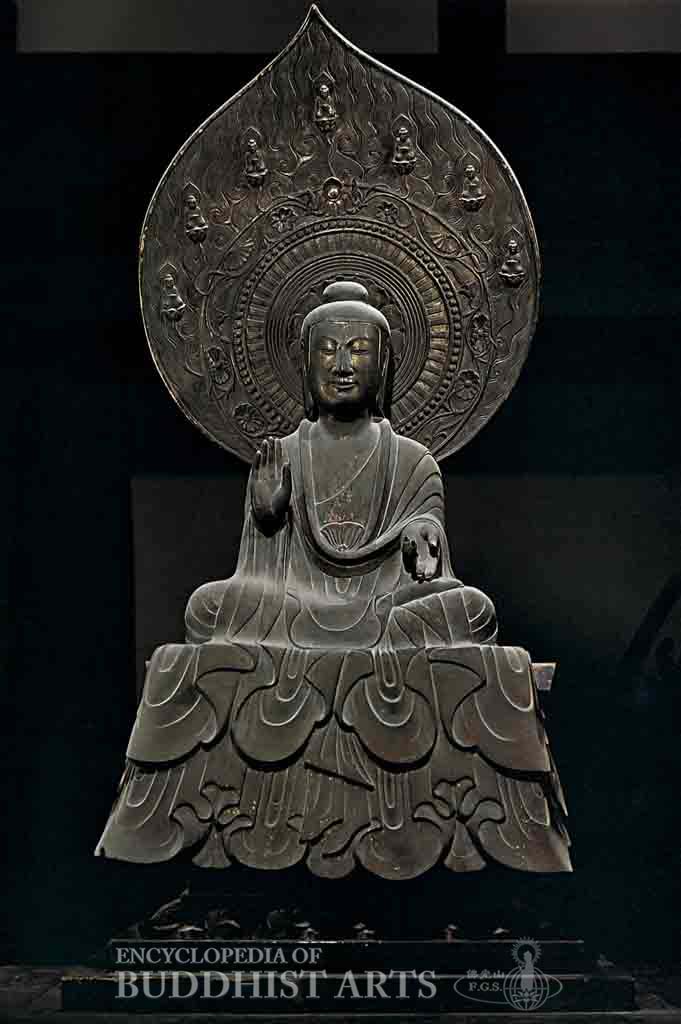
Horyuji Temple Golden Hall: Medicine Buddha
Gilt copper alloy
Horyuji Temple Golden Hall: Medicine Buddha
JAPAN, Nara, Ikoma; Asuka period
The inscription on the statue’s nimbus records that Emperor Yomei (reigned 585–587) had vowed to build a temple and a statue of the Medicine Buddha to pray for good health. The emperor passed away before completing his vow so Emperor Suiko (reigned 593–628) and Crown Prince Shotoku fulfilled this vow and completed the statue in 607. The genuineness of this inscription is doubtful so no exact date can be ascribed. The statue was listed as a National Treasure in 1952.
The statue was cast using the lost-wax method. The figure has a rounded usnisa, with traces of curls once pasted onto it. The right hand is raised in abhaya (fearlessness) mudra. The skirt overlaps the pedestal and the bold lines of its folds are echoed by the cloth beneath. The radiating nimbus has an outer rim of lotus tendrils and is enclosed by flame patterns where seven manifestations of the Buddha are seated on lotuses.
Although the face, hands and clothing are similar to the Sakyamuni statue kept in the same hall, the shoulders and knees are strikingly softer and more rounded, a clear influence from the Chinese dynasties of the Northern Qi (550–577), Northern Zhou (557–581), and Sui (581–618). This has led experts to believe that the statue was created in the late 7th century.
For more details, go to the Encyclopedia of Buddhist Arts: Sculpture G-M, page 454.
Cite this article:
author = Hsingyun and Youheng and Lovelock, Yann and Chou, Yuan and Huntington, Susan and Edson, Gary and Neather, Robert,
booktitle = {Encyclopedia of Buddhist Arts: Sculpture G-M},
pages = 454,
title = {{Horyuji Temple Golden Hall: Medicine Buddha}},
volume = 11,
year = {2016}}