
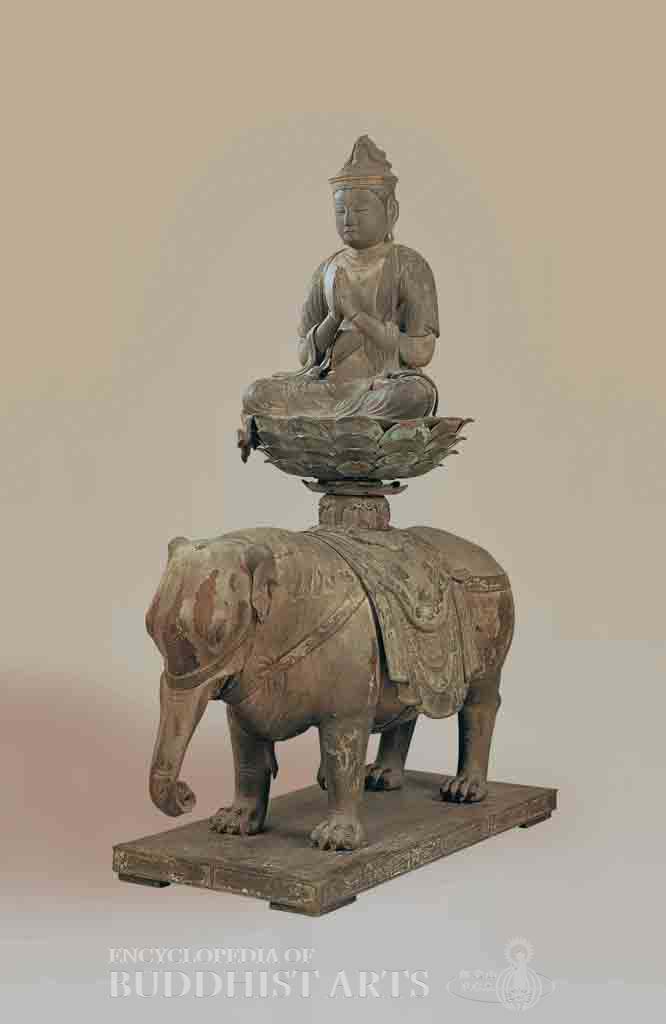
Samantabhadra Bodhisattva
Cypress wood
Samantabhadra Bodhisattva
JAPAN; Heian period
It is said in the Samantabhadra Meditation Sutra, that upon its recitation Samantabhadra will appear from the east, mounted on a six-tusked white elephant, offering protection. The sutra was popular in Japan during the late Heian period (794–1185), from which this statue dates. The sculpture was recognized as a National Treasure in 1967.
Samantabhadra is depicted making the anjali (reverence) mudra and seated in full lotus posture on a lotus throne. The throne is mounted on a seven-jeweled saddle on the back of a caparisoned elephant. The Bodhisattva wears an elaborate headdress kept in place by a fillet. The figure is wrapped in stoles that fall over the arms to the skirt beneath. Missing from the work is the Bodhisattva’s mandorla, the elephant’s tusks and the lotuses under its feet. There are traces of paint on the surface.
For more details, go to the Encyclopedia of Buddhist Arts: Sculpture N-Sr, page 941.
Cite this article:
author = Hsingyun and Youheng and Lovelock, Yann and Chou, Yuan and Huntington, Susan and Edson, Gary and Neather, Robert,
booktitle = {Encyclopedia of Buddhist Arts: Sculpture N-Sr},
pages = 941,
title = {{Samantabhadra Bodhisattva}},
volume = 12,
year = {2016}}