
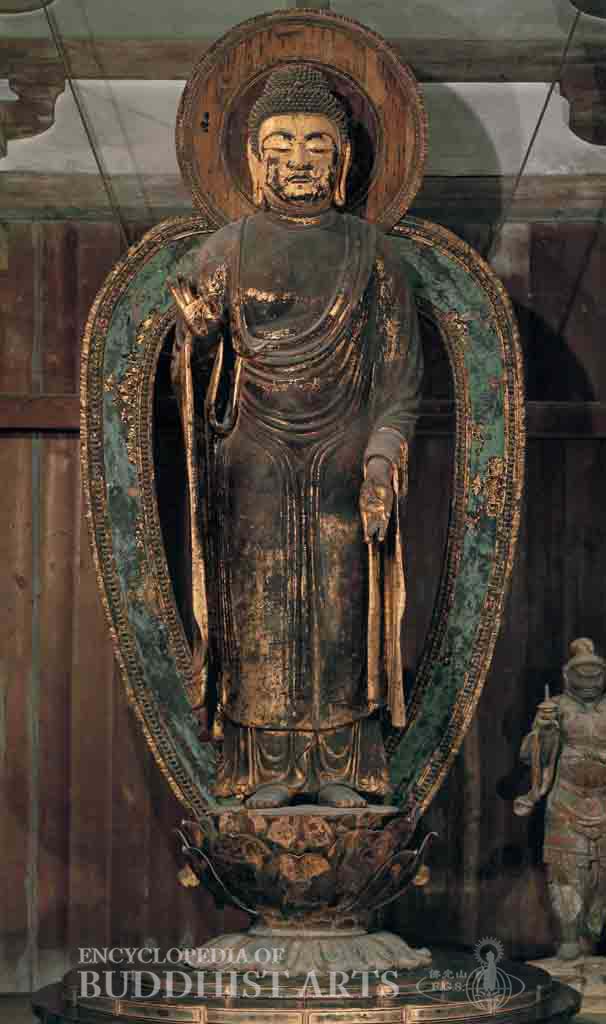
Toshodaiji Temple Golden Hall: Medicine Buddha
Cypress wood
Toshodaiji Temple Golden Hall: Medicine Buddha
JAPAN, Nara; Heian period
This sculpture of a standing Medicine Buddha was possibly carved after the passing of Master Jianzhen by his Chinese disciple Rubao. Three antiquated coins were discovered hidden in the left palm of the statue during restoration. One of the coins is from the year 796 of the Heian period, which suggests a creation date soon afterwards. The Buddha stands with right hand raised and the left hand opening downward. This posture differs from the conventional representation of Medicine Buddha as seated and holding a medicine jar. The statue was listed as a National Treasure in 1952.
Most of the statue was carved from a solid piece of cypress wood that was hollowed and the forearms were attached. Detail was added using the wood-core dry lacquer technique and the work then gilded and colored. The Buddha has a rounded face, pronounced eyebrows, and pursed lips that are characteristic of early Heian sculptures. The figure is dressed in monastic robes that ripple down to the waist then fall perpendicularly to the shins. An intersecting aureole and nimbus with a pearl-patterned inner and outer surround rise from the back of the lotus pedestal.
For more details, go to the Encyclopedia of Buddhist Arts: Sculpture St-Z, page 1249.
Cite this article:
author = Hsingyun and Youheng and Lovelock, Yann and Chou, Yuan and Huntington, Susan and Edson, Gary and Neather, Robert,
booktitle = {Encyclopedia of Buddhist Arts: Sculpture St-Z},
pages = 1249,
title = {{Toshodaiji Temple Golden Hall: Medicine Buddha}},
volume = 13,
year = {2016}}