
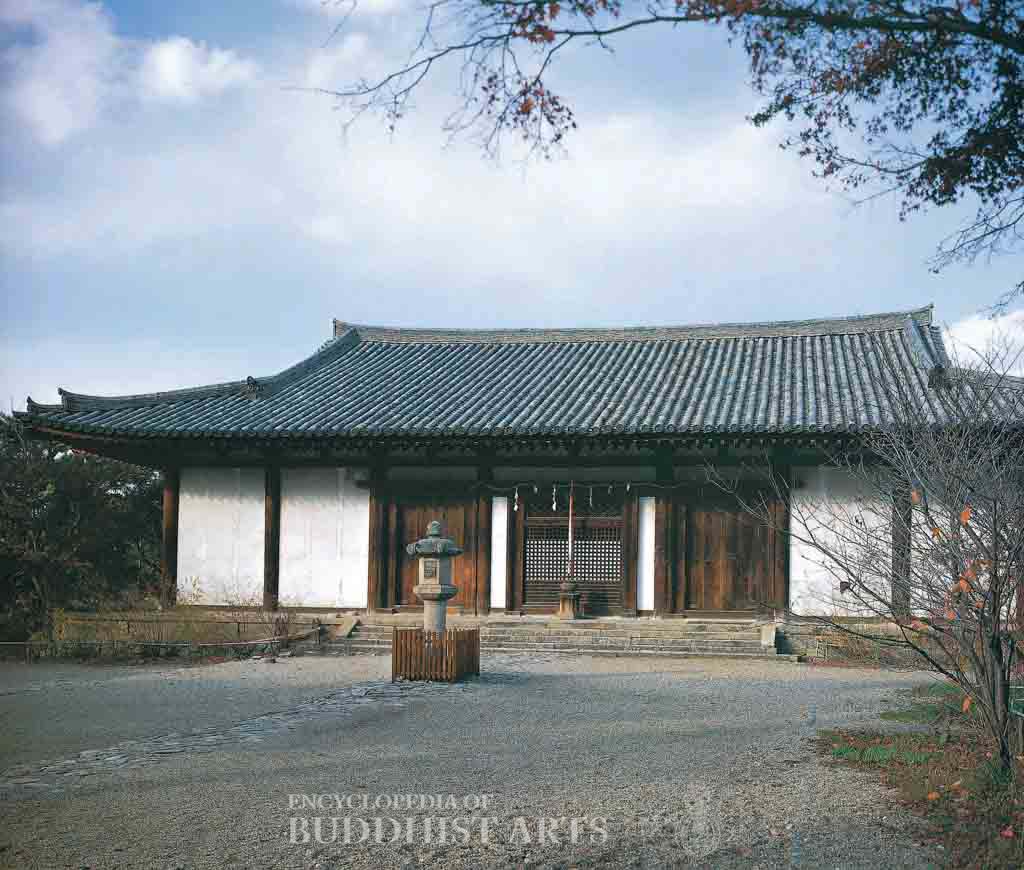
Shin Yakushiji Temple: Main Hall
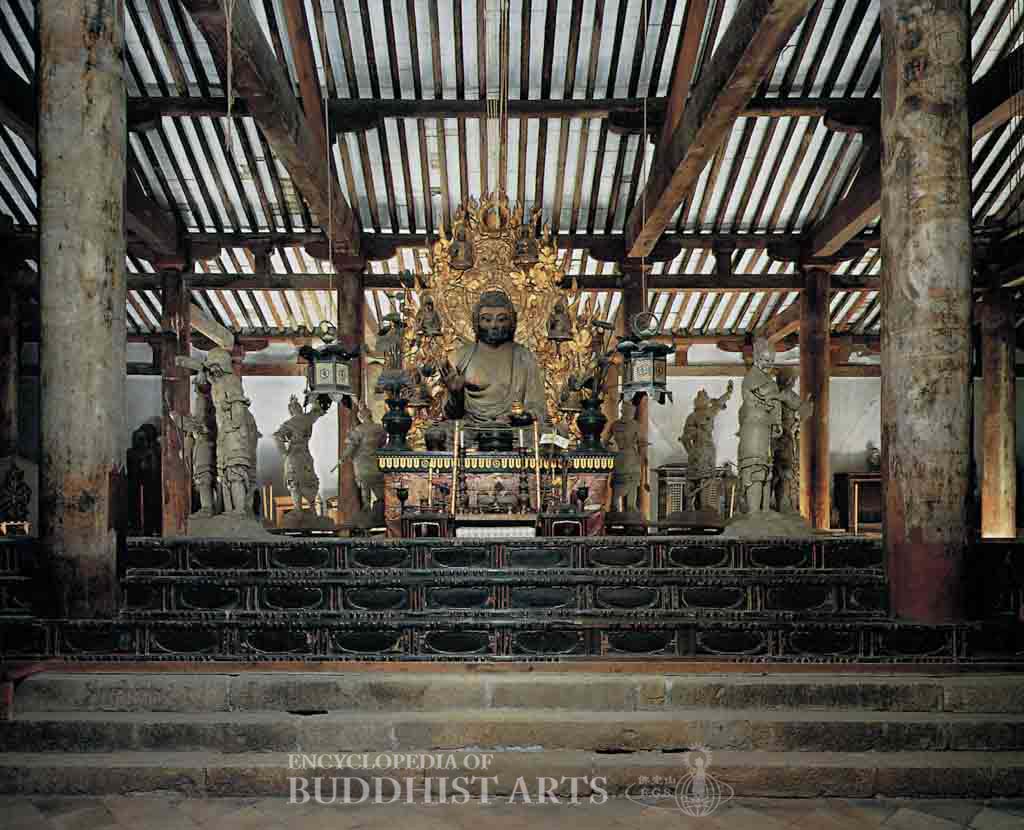
Shin Yakushiji Temple: Main Hall (interior)
Shin Yakushiji Temple
JAPAN, Nara
Shin means new, and Yakushi refers to the Medicine Buddha. The Shin Yakushiji Temple, which is also known as Koyakuji Temple, belongs to the Kegon school of Japanese Buddhism. It is the 6th of the 49 Medicine Buddha temples of the Yakushi Pilgrimage of southern-central Japan. It was founded by Empress Komyo in 747 in the hope that her husband, Emperor Shomu (reigned 724–749), would recover from an eye disease. Buildings were added to the temple compound during the second half of the 8th century. Some of the buildings were destroyed by fire in 780 and by a typhoon in 962. Reconstruction took place during the Kamakura period (1185–1333). In the Edo period, the temple was supported by General Tokugawa Ieyasu and Keishoin, mother of Tokugawa Tsunayoshi.
The principal buildings of the temple include the main hall, the south gate, east gate, bell tower, Ksitigarbha Hall, and the Fragrant Medicine Hall. The seven-by-five bay main hall dates back to the Nara period (710–794). It was listed as a National Treasure in 1952. The walls are made of clay and there are doors on all four sides. It has a gently sloping single-eave hip-and-gable roof covered with cylindrical tiles. On top of the pillars that support the roof there are large bearing blocks with bracket arms inserted into them. The ceiling is supported by interconnecting beams and rafters. The characteristics of Nara-period architecture have been preserved. The circular altar in the middle of the hall has a statue of a seated Medicine Buddha, surrounded by Twelve Yaksa Generals. They were listed as National Treasures.
For more details, go to the Encyclopedia of Buddhist Arts: Architecture M-S, page 995.
Cite this article:
author = Hsingyun and Youheng and Johnson, Peter and Mankuang and Lancaster, Lewis,
booktitle = {Encyclopedia of Buddhist Arts: Architecture M-S},
pages = 995,
title = {{Shin Yakushiji Temple}},
volume = 3,
year = {2016}}