
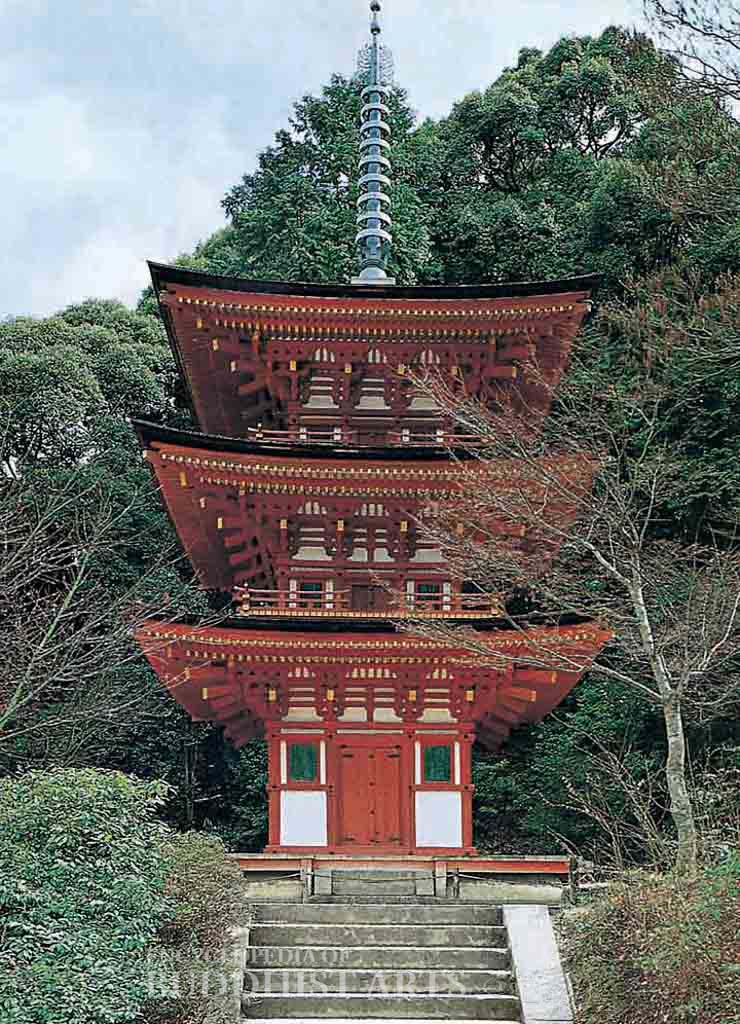
Joruriji Temple Three-Story Pagoda
Joruriji Temple Three-Story Pagoda
JAPAN, Kyoto, Kizugawa
This is the only remaining Heian period (794–1185) three-story pagoda in Kyoto and is believed to have been built in 1178. It was listed as a National Treasure in 1952.
The three-by-three bay square pagoda is 16.1 m high with a roof covered with cypress bark. There is a central pillar starting on the second story, which is a unique feature of this pagoda. There are doors on all four sides and the body is painted in a balanced combination of red and white. The spire consists of nine stacked rings, a flame, and a jewel. A statue of a seated Medicine Buddha is enshrined in the first story. Images of the Sixteen Arhats are painted on the walls. The Heavenly Beings of the Eight Directions and the Trees of the Seven Treasures which are painted on the columns, as well as the Lotus Sutra Mandala and the flower motifs which decorate the door panels are all listed as Important Cultural Properties.
For more details, go to the Encyclopedia of Buddhist Arts: Architecture G-L, page 556.
Cite this article:
author = Hsingyun and Youheng and Johnson, Peter and Mankuang and Lancaster, Lewis,
booktitle = {Encyclopedia of Buddhist Arts: Architecture G-L},
pages = 556,
title = {{Joruriji Temple Three-Story Pagoda}},
volume = 2,
year = {2016}}