
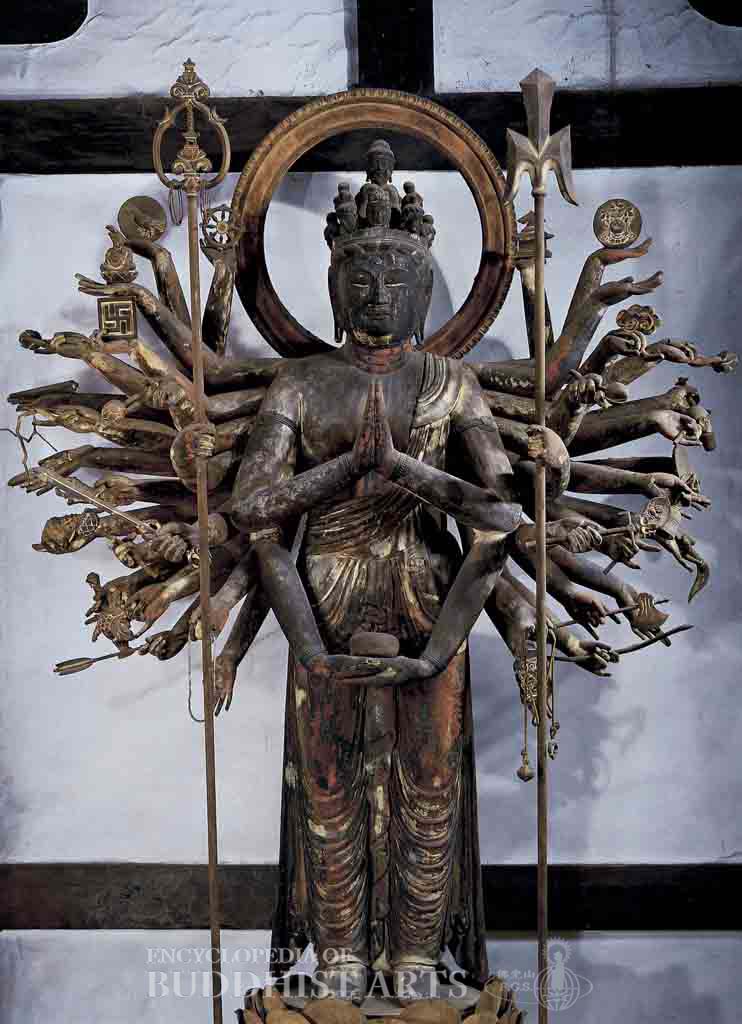
Koryuji Temple: Thousand-Armed Avalokitesvara
Cypress wood
Koryuji Temple: Thousand-Armed Avalokitesvara
JAPAN, Kyoto; Heian period
This statue from the mid-9th century was carved from cypress wood and then hollowed. It has been damaged over time and some of the paint has worn away to reveal the wood grain beneath. It is now kept at the temple’s Treasure Hall. It was listed as a National Treasure in 1953.
Avalokitesvara’s extra heads are arranged about a crown and backed by a hollow nimbus. The skirt is gathered between the legs and folds ripple beneath the knees. The thousand arms are represented by forty-two ranged about the body and holding the symbolic attributes of the Dharma, such as the Dharma wheel, swastika symbol, vajra and bell, sword of wisdom, and the Triple Gem symbol. Others are especially associated with the figure such as the lasso, prayer beads, sutra scroll, and lotuses in various stages of bloom signifying the past, present, and future. Two hands are joined in front in anjali (reverence) mudra while another pair holds an alms bowl. The monk’s staff and halberd held on either side symbolize the value of maintaining proper balance even amidst change.
For more details, go to the Encyclopedia of Buddhist Arts: Sculpture G-M, page 560.
Cite this article:
author = Hsingyun and Youheng and Lovelock, Yann and Chou, Yuan and Huntington, Susan and Edson, Gary and Neather, Robert,
booktitle = {Encyclopedia of Buddhist Arts: Sculpture G-M},
pages = 560,
title = {{Koryuji Temple: Thousand-Armed Avalokitesvara}},
volume = 11,
year = {2016}}