
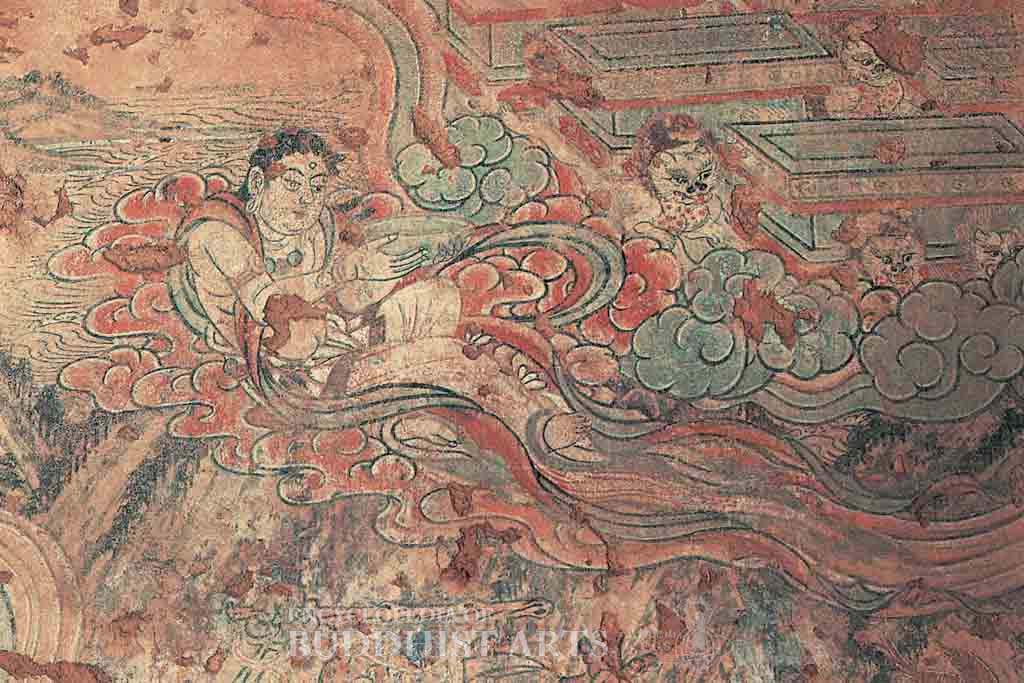
Dayun Yuan Temple Amitabha Hall Murals: Illustration of the Vimalakirti Sutra - Apsara
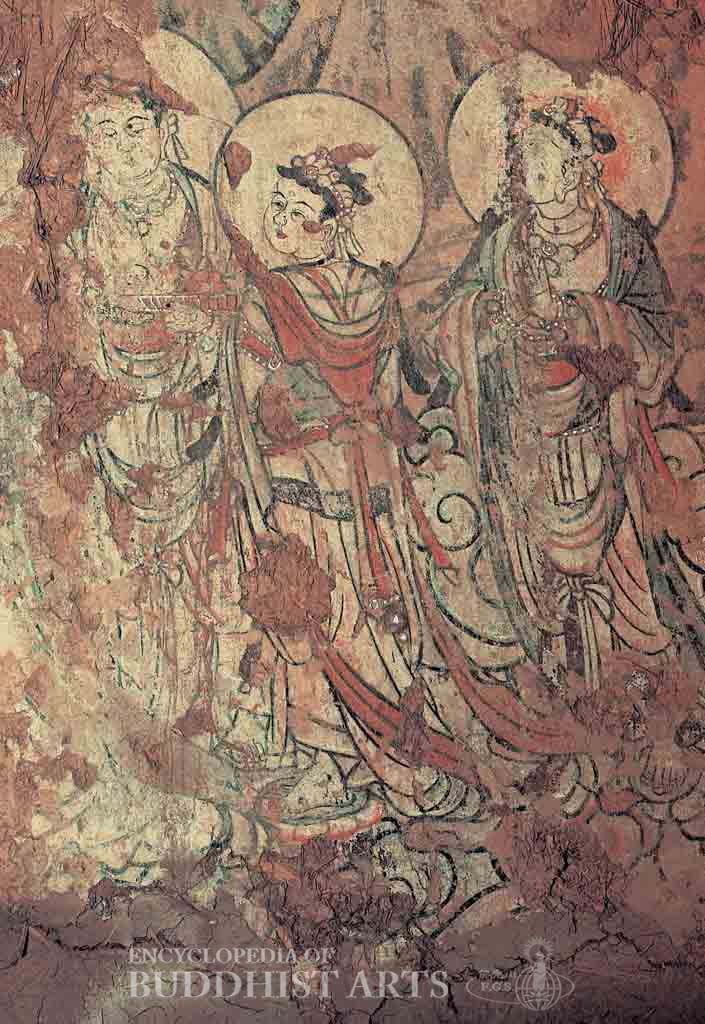
Dayun Yuan Temple Amitabha Hall Murals: Illustration of the Vimalakirti Sutra - Bodhisattvas
Dayun Yuan Temple Amitabha Hall Murals
CHINA, Shanxi, Changzhi; Later Jin dynasty
Dayun Yuan Temple is located in Changzhi, Shanxi. The Amitabha Hall was built in 940 during the Later Jin dynasty. These murals were painted soon after the construction of the hall. Due to exposure to rain during the rule of Emperor Kangxi (reigned 1661–1722) of the Qing dynasty, many of the murals have been damaged. Only 46 sq m of murals remain, found on the east wall, the right corners of the north wall, and on both sides of the partition wall.
On the east wall, Vimalakirti is shown on the left and Manjusri Bodhisattva is on the right. Both figures are surrounded by Bodhisattvas, disciples, Heavenly Kings, Dharma protectors, and attendants, all portrayed with different expressions and postures as they listen respectfully to Dharma teachings. Along the two sides of a table in the middle of the mural are Accumulated Fragrance Bodhisattva, Sariputra, and a heavenly maiden holding a flower. Accumulated Fragrance Bodhisattva holds an alms bowl filled with rice, while Sariputra stands with his palms joined. Two apsaras are painted in the upper register. On the north wall, only three unidentified standing Bodhisattvas remain. One is thought to be an attendant of a larger figure that is no longer visible, while the other two are making offerings.
The murals on the front of the partition wall are severely damaged. Part of the mandorla of the central figure, thought to have been Amitabha Buddha, is still visible. Standing to the sides of the mandorla are Avalokitesvara and Mahasthamaprapta Bodhisattvas, the attendant Bodhisattvas of Amitabha. The Pure Land is painted on the back of the partition. In the upper corners there are pavilions filled with Buddhas, Bodhisattvas, and figures making offerings. Six heavenly beings playing musical instruments are also depicted, dressed in the style of the Five Dynasties (907–960).
The murals are mainly colored in blue, white, and red. Asphalt powder laced with gold is applied on small details such as the ribbons, ornaments, and flowers on the Bodhisattvas and heavenly beings. The characters in the murals have delicate, sharp features, differing from the plump figures painted during the Late Tang period (846–907). However, many other features of the murals reflect the influence of the renowned Tang dynasty painter Wu Daozi. The only remaining Chinese temple murals from the time of Five Dynasties, these murals fill a gap in the history of Chinese religious painting and contribute to the understanding of the evolution of Buddhist art in China.
For more details, go to the Encyclopedia of Buddhist Arts: Painting A-H, page 187.
Cite this article:
author = Hsingyun and Youheng and Youlu and Wilson, Graham and Manho and Mankuang and Huntington, Susan,
booktitle = {Encyclopedia of Buddhist Arts: Painting A-H},
pages = 187,
title = {{Dayun Yuan Temple Amitabha Hall Murals}},
volume = 14,
year = {2016}}