
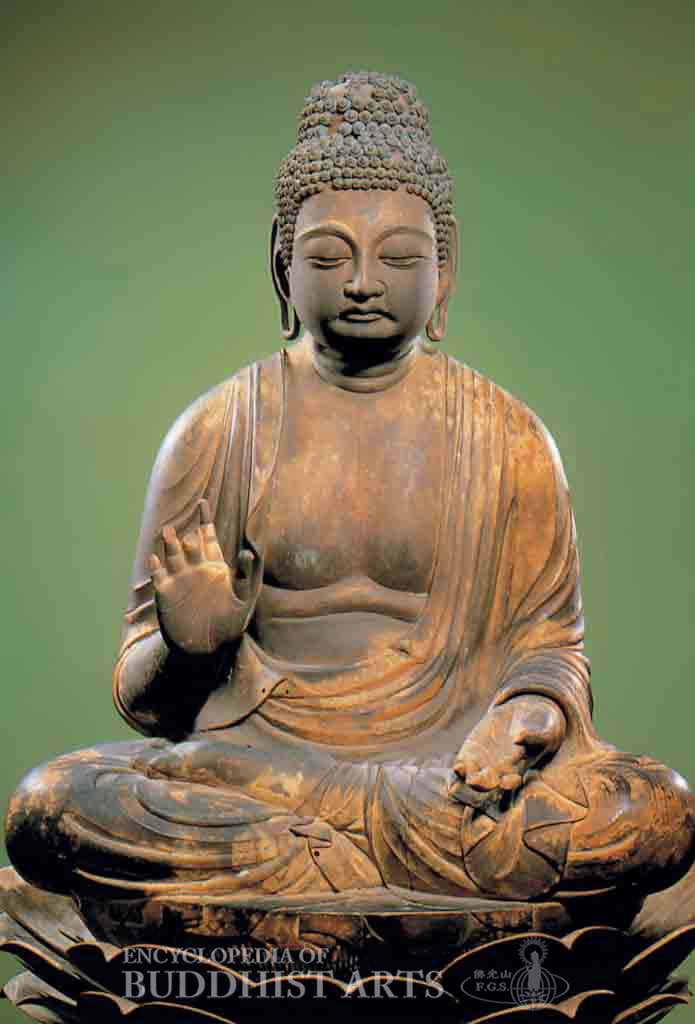
Medicine Buddha
Cypress wood
Medicine Buddha
JAPAN; Heian period
The figure was said to be originally located at Higashiyama Ward in Kyoto but later moved when ownership of the sculpture was assumed by the state during the Meiji period (1868–1912). After the statue was carved, the lower portion of the arms was hollowed and the hands fitted into them, a method often seen in wooden sculptures from the Heian period. It was declared a National Treasure in 1953.
The Medicine Buddha has a high usnisa covered in curls and finished with dry lacquer, beneath which the gaze is absorbed. The figure wears monastic robes and sits in half lotus position on a layered lotus throne. The damaged right hand is lifted in abhaya (fearlessness) mudra, while the left rests on the knee in varada (wish-granting) mudra.
For more details, go to the Encyclopedia of Buddhist Arts: Sculpture G-M, page 712.
Cite this article:
author = Hsingyun and Youheng and Lovelock, Yann and Chou, Yuan and Huntington, Susan and Edson, Gary and Neather, Robert,
booktitle = {Encyclopedia of Buddhist Arts: Sculpture G-M},
pages = 712,
title = {{Medicine Buddha}},
volume = 11,
year = {2016}}