
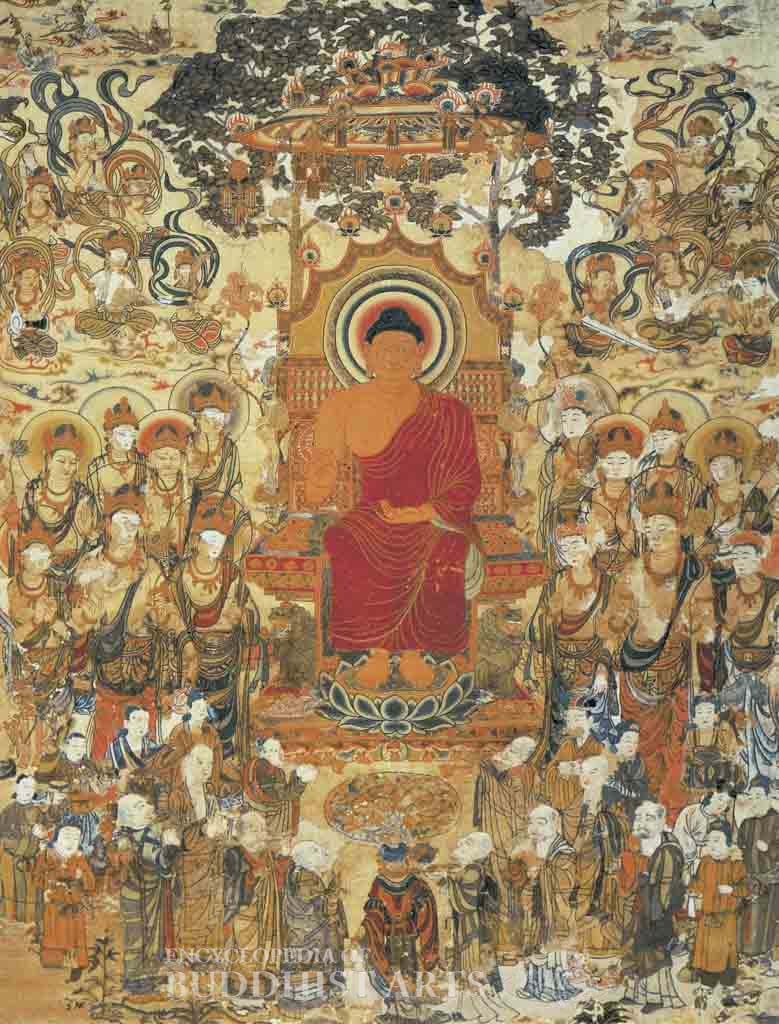
Embroidery of the Buddha Teaching the Dharma at Vulture Peak
Silk
Embroidery of the Buddha Teaching the Dharma at Vulture Peak
CHINA; Tang dynasty
The provenance of this embroidery is unknown. It was either created in China during the Tang dynasty (618–907) and taken to Japan, or it was made in Japan during the Nara period (710–794). It was kept at Kajuji Temple in Kyoto for centuries, and is thus also known as the Kajuji Temple Embroidery. It was repaired and framed in 1635, and in 1952, it was listed as a National Treasure of Japan.
The embroidery shows Sakyamuni Buddha teaching the Lotus Sutra on Vulture Peak. He sits in the center on a lion throne under a canopy with suspended jeweled beads. Bodhisattvas stand on both sides, while the Ten Great Disciples and figures making offerings are below. Heavenly musicians sit on clouds playing musical instruments on both sides of the upper register, while sages riding on phoenixes appear at the top.
The background consists of thick pale-yellow woven silk fabric. It is embroidered using a chain stitch with color silk threads, including red, purple, blue, and shades of green. Different embroidery techniques are used throughout this piece of art. The composition is neatly balanced to produce a magnificent scene.
For more details, go to the Encyclopedia of Buddhist Arts: Artifacts, page 80.
Cite this article:
author = Hsingyun and Youheng and Youji and Pokorski, Stefanie and Mankuang and Fan, Wen,
booktitle = {Encyclopedia of Buddhist Arts: Artifacts },
pages = 80,
title = {{Embroidery of the Buddha Teaching the Dharma at Vulture Peak}},
volume = 18,
year = {2016}}