
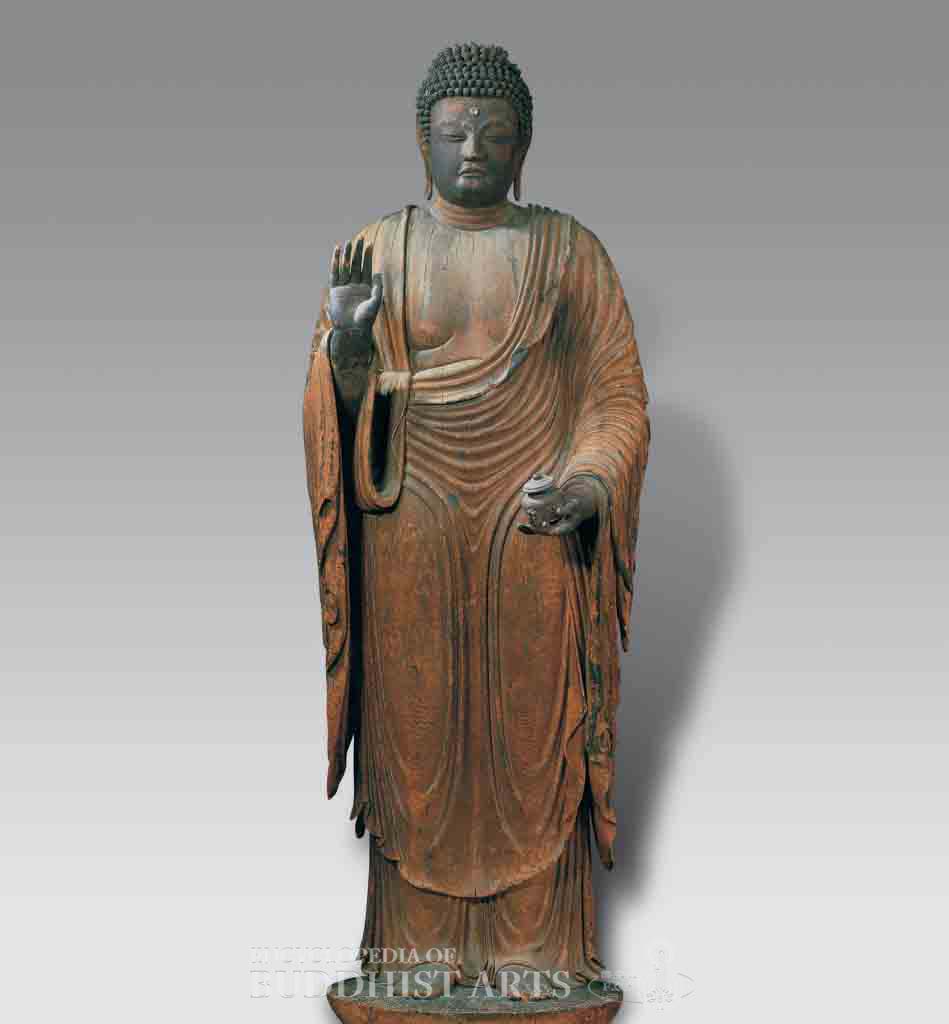
Gangoji Temple: Medicine Buddha
Nutmeg wood
Gangoji Temple: Medicine Buddha
JAPAN, Nara; Heian period
This early 9th century figure was carved from a block of nutmeg wood and then hollowed. The statue was listed as a National Treasure in 1952.
The Buddha’s right hand is in abhaya (fearlessness) mudra, while the left hand holds out a medicine pot. The monastic robes have folds that drape to outline the thighs, a characteristic typical of the early Heian period (794–1185) style. The lower robe reaches the ankles. Snail-shell curls cover the small head, which has a crystal for an urna. The eyes are narrowed beneath the unruly brows and the pronounced lips are turned down in the majestic face. Some experts believe the statue was created by craftsmen that arrived with the Chinese Master Jianzhen, or were created by sculptors that were apprenticed under them.
For more details, go to the Encyclopedia of Buddhist Arts: Sculpture G-M, page 368.
Cite this article:
author = Hsingyun and Youheng and Lovelock, Yann and Chou, Yuan and Huntington, Susan and Edson, Gary and Neather, Robert,
booktitle = {Encyclopedia of Buddhist Arts: Sculpture G-M},
pages = 368,
title = {{Gangoji Temple: Medicine Buddha}},
volume = 11,
year = {2016}}