
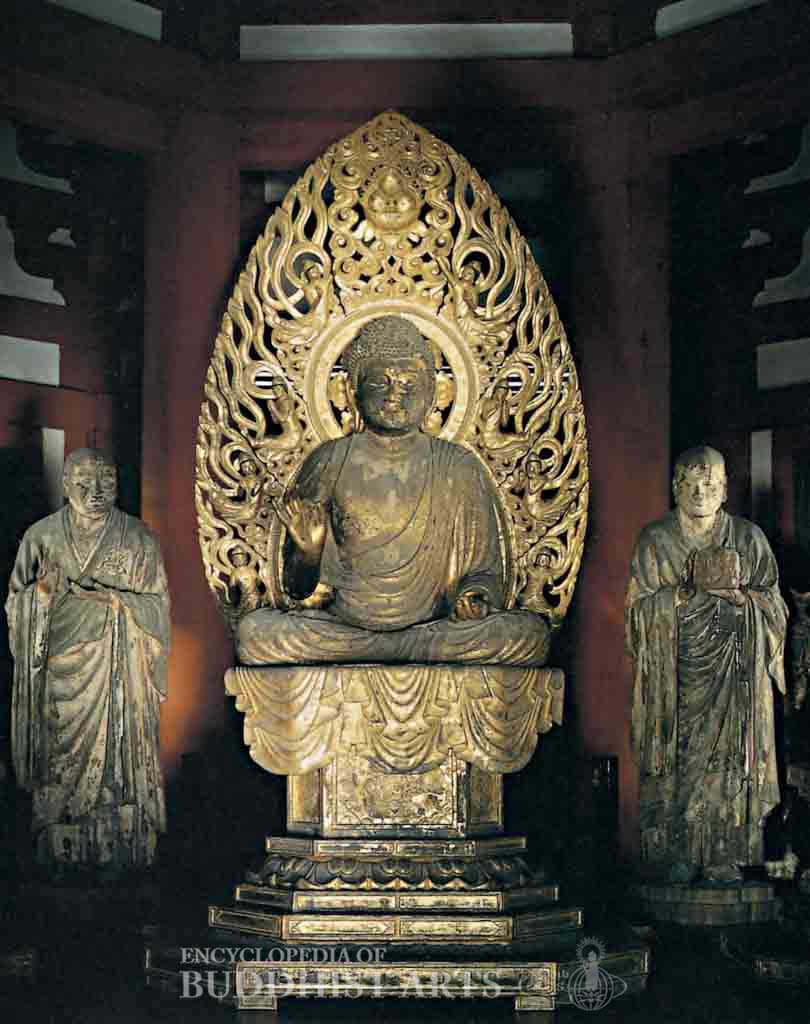
Kofukuji Temple North Octagonal Hall: Maitreya Buddha
Laurel wood
Kofukuji Temple North Octagonal Hall: Maitreya Buddha
JAPAN, Nara; Kamakura period
The statue of Maitreya Buddha is flanked by Asanga and Vasubandhu. An inked inscription on the plinth states that the reconstruction of the templed started in 1208. It was led by Unkei, who together with his son and dozens of apprentices, produced the sculptures in the hall. Maitreya is assembled from four pieces of hollowed laurel wood. The surface is lacquered and finished with gold foil and the eyes inlaid with precious stones. During restoration in 1934, many votive artifacts, prayers and vows were discovered inside. The figure was listed as a National Treasure in 1951.
Instead of being depicted as a Bodhisattva, Maitreya is portrayed as already enlightened. The right hand is raised in vitarka (teaching) mudra, while the left hand rests palm upwards on the knee with fingers slightly curled. The figure sits cross-legged on an octagonal Sumeru throne draped with a stylized sitting cloth. The dignified figure is solidly balanced and his monastic robe is carved in low relief, hanging realistically to fold over his legs in a rippling pattern. An openwork mandorla frames the Buddha. There are eight apsaras inside, whose fluttering stoles form the edges to give the mandorla its form. The Triple Gem is depicted at the top.
For more details, go to the Encyclopedia of Buddhist Arts: Sculpture G-M, page 549.
Cite this article:
author = Hsingyun and Youheng and Lovelock, Yann and Chou, Yuan and Huntington, Susan and Edson, Gary and Neather, Robert,
booktitle = {Encyclopedia of Buddhist Arts: Sculpture G-M},
pages = 549,
title = {{Kofukuji Temple North Octagonal Hall: Maitreya Buddha}},
volume = 11,
year = {2016}}