
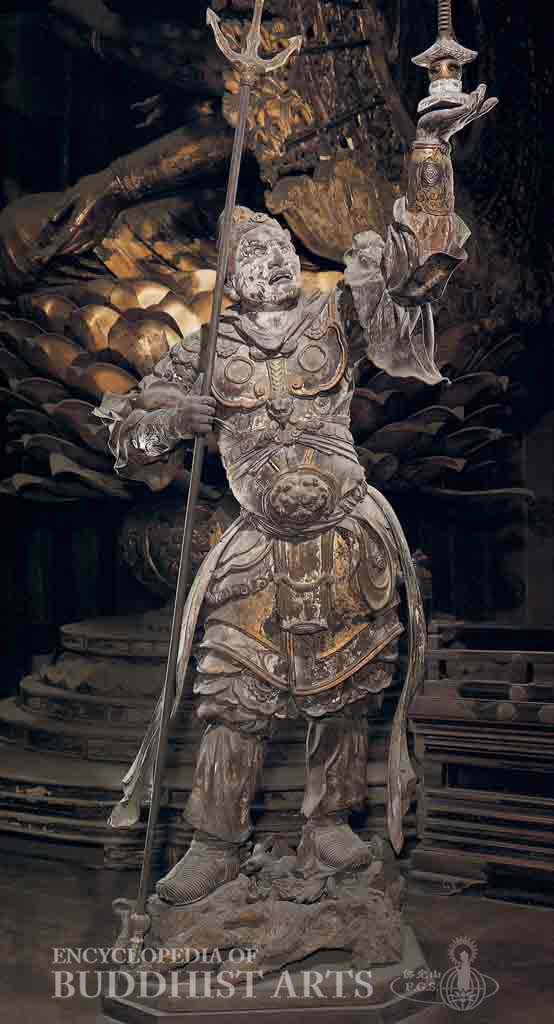
Kofukuji Temple South Octagonal Hall: Four Heavenly Kings - Vaisravana
Laurel wood
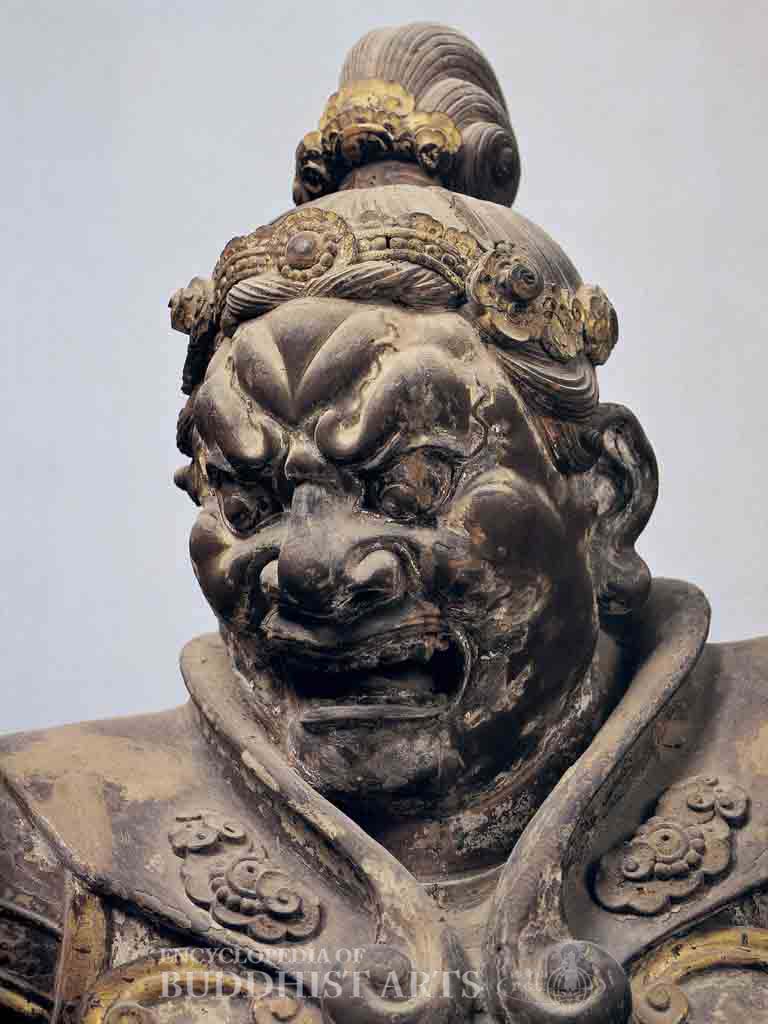
Kofukuji Temple South Octagonal Hall: Four Heavenly Kings - Virudhaka (detail)
Kofukuji Temple South Octagonal Hall: Four Heavenly Kings
JAPAN, Nara; Kamakura period
The Four Heavenly Kings occupy the four directions in the hall. Slightly over life size, they are assembled from several pieces of laurel wood. The styles and manner of dressing are modeled upon those of the Nara period (710–794), but they have been attributed to the later sculptors Jokei and Unkei, who were noted for their naturalism. These sculptures were listed as National Treasures in 1954.
The large, dominating figures are depicted in varied postures. Each figure has hair tied in a topknot and wears a golden fillet. Their expressions are ferocious, with knitted brow and downturned mouth. The carving of the sleeves of the tunic is realistically and energetically worked. The motifs on the full-body armor are varied and imaginative, for instance, the beast’s head with spine molded on Vaisravana’s breastplate.
All the figures are standing on rocks, with one foot higher than the other, their bodies twisting dynamically. Vaisravana, Heavenly King of the North, looks up at the pagoda he raises in his left hand. In his right hand, he balances a trident. Both Vidrudhaka, Heavenly King of the South and Virupaksa, Heavenly King of the West have their right hands at the waist and a trident in their left hands. Dhrtarastra, Heavenly King of the East is weighing his sword in both hands and is running his eye along the blade.
For more details, go to the Encyclopedia of Buddhist Arts: Sculpture G-M, page 550.
Cite this article:
author = Hsingyun and Youheng and Lovelock, Yann and Chou, Yuan and Huntington, Susan and Edson, Gary and Neather, Robert,
booktitle = {Encyclopedia of Buddhist Arts: Sculpture G-M},
pages = 550,
title = {{Kofukuji Temple South Octagonal Hall: Four Heavenly Kings}},
volume = 11,
year = {2016}}