
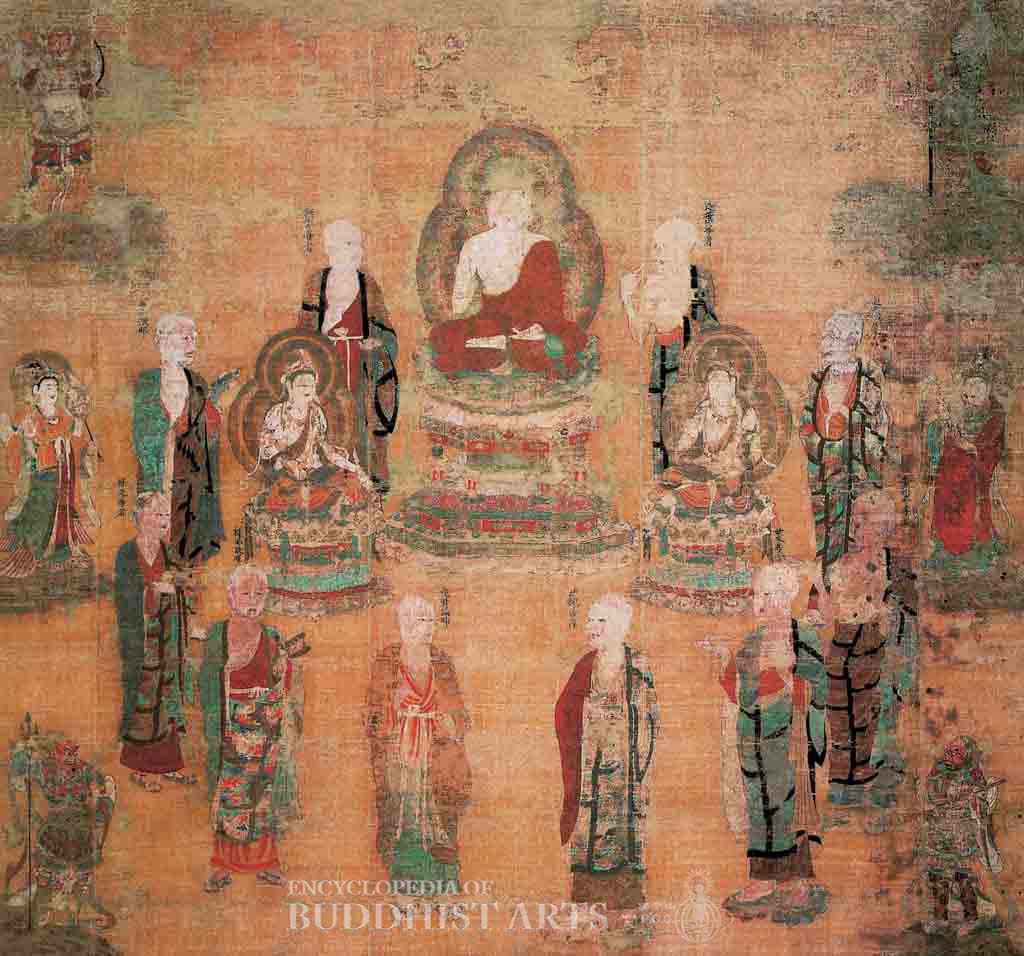
Todaiji Temple: Kusha Mandala
Ink and color on silk
Todaiji Temple: Kusha Mandala
JAPAN, Nara; Heian period
This mandala depicts the patriarchs of the Kusha school standing beside the Buddha, Bodhisattvas, and great disciples. It is thought to have been painted in the 12th century by the monk Kakuju of Todaiji Temple and his disciple Chinkai as part of an attempt to revive the Kusha school teachings that are based on the Abhidharmakosa Sastra, a Sanskrit text that systematically describes reality according to the teachings of the Buddha. The depictions of the patriarchs in the mandala are inspired by Nara period (719–794) paintings of monks. Thus, the style differs from most other Heian period artworks. The mandala was listed as a National Treasure in 1953.
Sakyamuni Buddha sits on a lotus throne in the center of the upper register, flanked by Manjusri and Samantabhadra Bodhisattvas. Great disciples and the patriarchs of the Kusha school are arranged in a circle around the triad. Beginning from the upper right and moving clockwise, there are depictions of Mahakasyapa, Katyayaniputra, Sariputra, Vasumitra, Vasubandhu, Sanghabhadra, Devasarman, Maudgalyayana, Katyayana, and Ananda. Brahma, wearing a red robe, is painted on the right outside the circle of figures. Sakra stands on the far left. The Four Heavenly Kings occupy the four corners.
For more details, go to the Encyclopedia of Buddhist Arts: Painting P-Z, page 913.
Cite this article:
author = Hsingyun and Youheng and Youlu and Wilson, Graham and Manho and Mankuang and Huntington, Susan,
booktitle = {Encyclopedia of Buddhist Arts: Painting P-Z},
pages = 913,
title = {{Todaiji Temple: Kusha Mandala}},
volume = 16,
year = {2016}}