
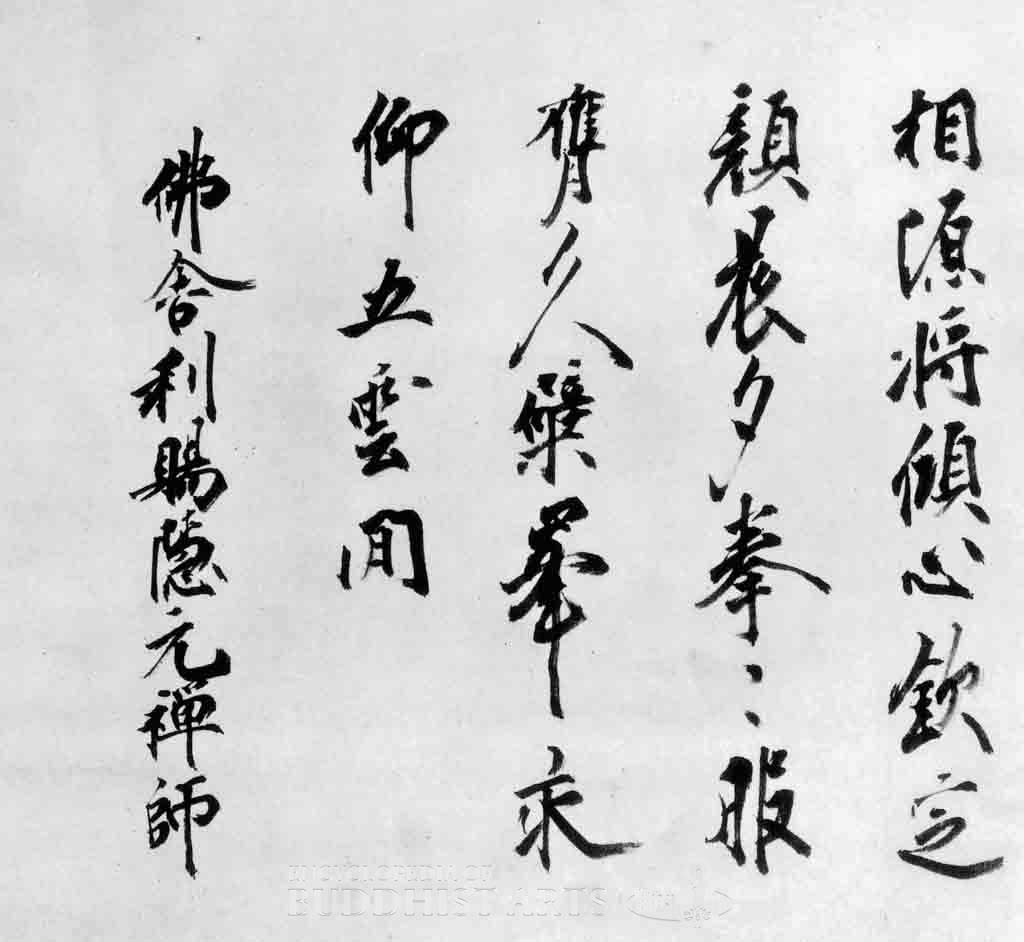
Manpukuji Temple Shoindo Hall: Dedication of Relics to Master Yinyuan Longqi (detail)
Ink on paper
Manpukuji Temple Shoindo Hall: Dedication of Relics to Master Yinyuan Longqi
JAPAN, Kyoto; Edo period
Emperor Go-Mizunoo presented a gift of 5 Buddha relics to Chan Master Yinyuan Longqi, who was also known as Ingen Ryuki in Japan, in 1666. Master Yinyuan initially preserved them in the Shoindo Hall of Manpukuji Temple in Kyoto. The emperor subsequently sponsored the construction of a Relic Hall for the purpose of housing the relics and wrote this inscription as a dedication.
The generously proportioned characters suggest that the calligrapher adopted the sparse and stark style of Chan, resulting in sharp and straight strokes, and a contrast of condensed characters composed within amply spaced lines. The product of this stylistic rendering is a dynamic composition paired with a strong, yet uncluttered, visual semblance.
Emperor Go-Mizunoo (reigned 1611–1629) was the 108th emperor of Japan. He was also known by his nickname, Sangu, and his style name, Gyokuro. A devout Buddhist, he renounced in 1651. Talented in several areas of the arts, he authored an impressive collection of poems and verses in addition to his calligraphic contributions.
For more details, go to the Encyclopedia of Buddhist Arts: Calligraphy, page 152.
Cite this article:
author = Hsingyun and Youheng and Youlu and Pokorski, Stefanie and Mankuang and Edson, Gary,
booktitle = {Encyclopedia of Buddhist Arts: Calligraphy },
pages = 152,
title = {{Manpukuji Temple Shoindo Hall: Dedication of Relics to Master Yinyuan Longqi}},
volume = 17,
year = {2016}}