
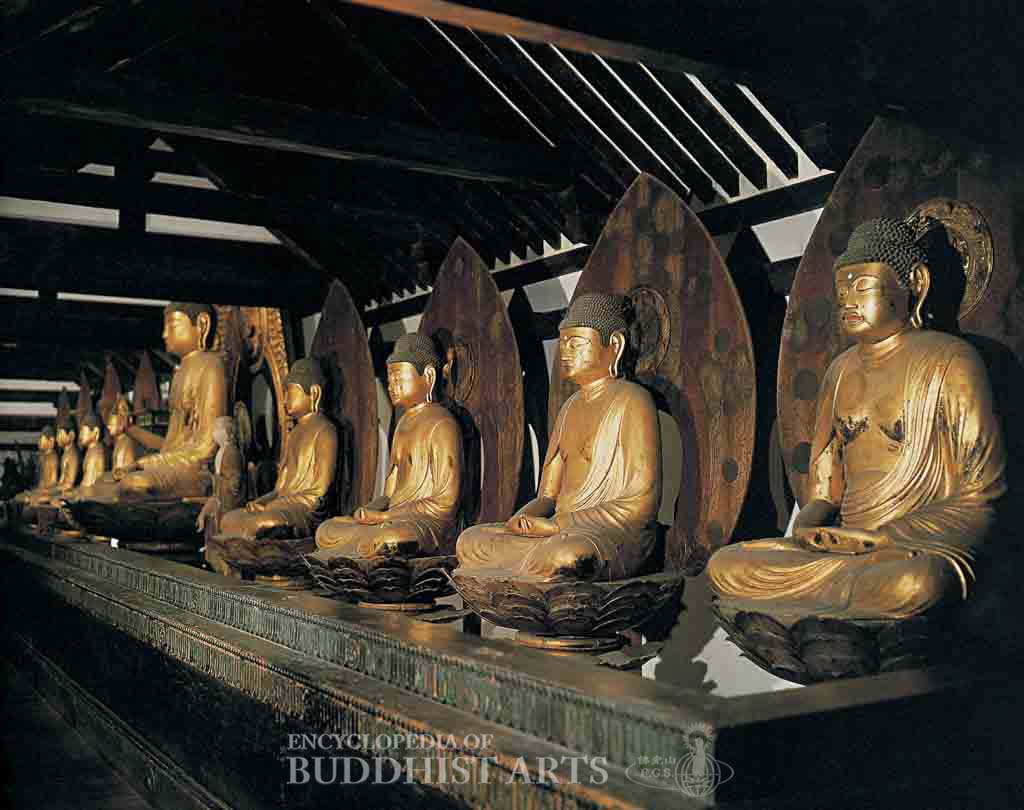
Joruriji Temple Main Hall: Amitabha Buddhas
Cypress wood
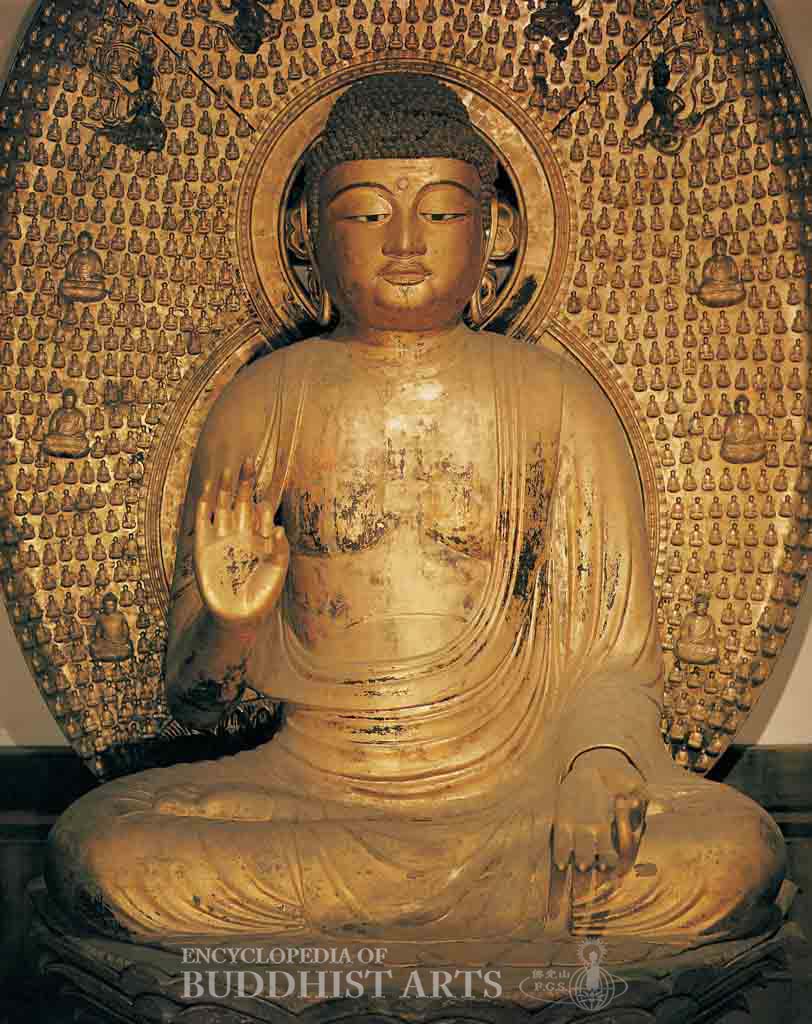
Joruriji Temple Main Hall: Amitabha Buddha
Joruriji Temple Main Hall: Amitabha Buddhas
JAPAN, Kyoto, Kizugawa; Heian period
These sculptures were produced between the 11th and 12th century and represent the Nine Grades of Rebirth described in the Amitayurdhyana Sutra. The statues of Amitabha are seated in a row. The central Buddha gestures in the lowest grade of the highest class mudra, while the remaining figures, with four on each side, form the highest grade of the highest class mudra specially connected with statues of Amitabha. They are the only extant works of this Buddha from the Heian period (794–1185) and were recognized as National Treasures in 1952.
The statues are carved with relatively similar techniques: the torso is formed with several pieces of cypress wood hollowed and then joined together, and the finished form is lacquered, painted and covered with gold foil. The central figure, 224 cm high, is seated on a throne 115 cm high, while the rest of the statues are around 139 cm to 145 cm in height. All figures are seated in full lotus posture on lotus thrones backed by petal-shaped mandorlas with a gilded nimbus behind each head. The figures are dressed in monastic robes, the folds and creases of which are carved in low relief. The overall composition is calm, stable, balanced, and elegant.
The spectacular mandorla of the figure at the center is filled with numerous miniature manifestations upon which four apsaras and seven meditating Buddhas are superimposed, with Sakyamuni Buddha seated cross-legged at the top.
For more details, go to the Encyclopedia of Buddhist Arts: Sculpture G-M, page 510.
Cite this article:
author = Hsingyun and Youheng and Lovelock, Yann and Chou, Yuan and Huntington, Susan and Edson, Gary and Neather, Robert,
booktitle = {Encyclopedia of Buddhist Arts: Sculpture G-M},
pages = 510,
title = {{Joruriji Temple Main Hall: Amitabha Buddhas}},
volume = 11,
year = {2016}}