
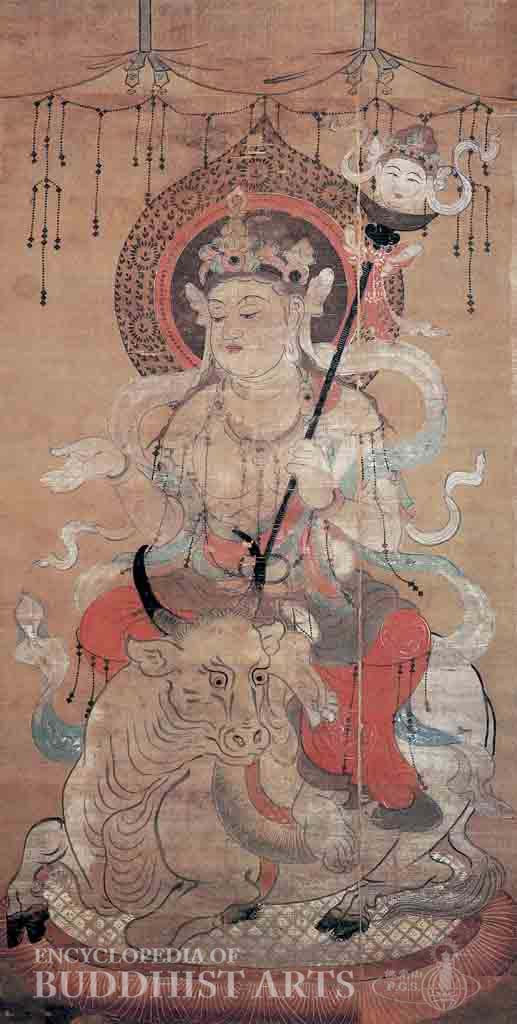
Daigoji Temple: Yama
Ink and color on silk
Daigoji Temple: Yama
JAPAN, Kyoto; Kamakura period
Yama is one of the Twelve Heavenly Beings and guards the south. In Shingon Buddhism, Yama is said to cure diseases, prevent disasters, prolong life, and ensure healthy births. It is speculated that this 12th century painting was dedicated to Fujiwara no Tamako, the mother of Emperor Sutoku (reigned 1123–1141) of the Heian period, for smooth delivery of a new baby. It was listed as a National Treasure in 1956.
Yama appears as a heavenly being with a robust figure, a round face, arched eyebrows, and lowered eyes. Sitting in a relaxed posture on the back of a buffalo, Yama holds the head-topped staff (dandato) in the left hand. Strings of beads hang from Yama’s arms and legs, and from a canopy at the top of the image. The image is drawn with smooth, flowing ink lines. The nimbus is decorated with a unique pattern embellished with silver foil, a common characteristic of Buddhist paintings from the Heian period (794–1185). The subdued, elegant coloring reflects the influence of Chinese Song dynasty (960–1279) art.
For more details, go to the Encyclopedia of Buddhist Arts: Painting A-H, page 178.
Cite this article:
author = Hsingyun and Youheng and Youlu and Wilson, Graham and Manho and Mankuang and Huntington, Susan,
booktitle = {Encyclopedia of Buddhist Arts: Painting A-H},
pages = 178,
title = {{Daigoji Temple: Yama}},
volume = 14,
year = {2016}}