
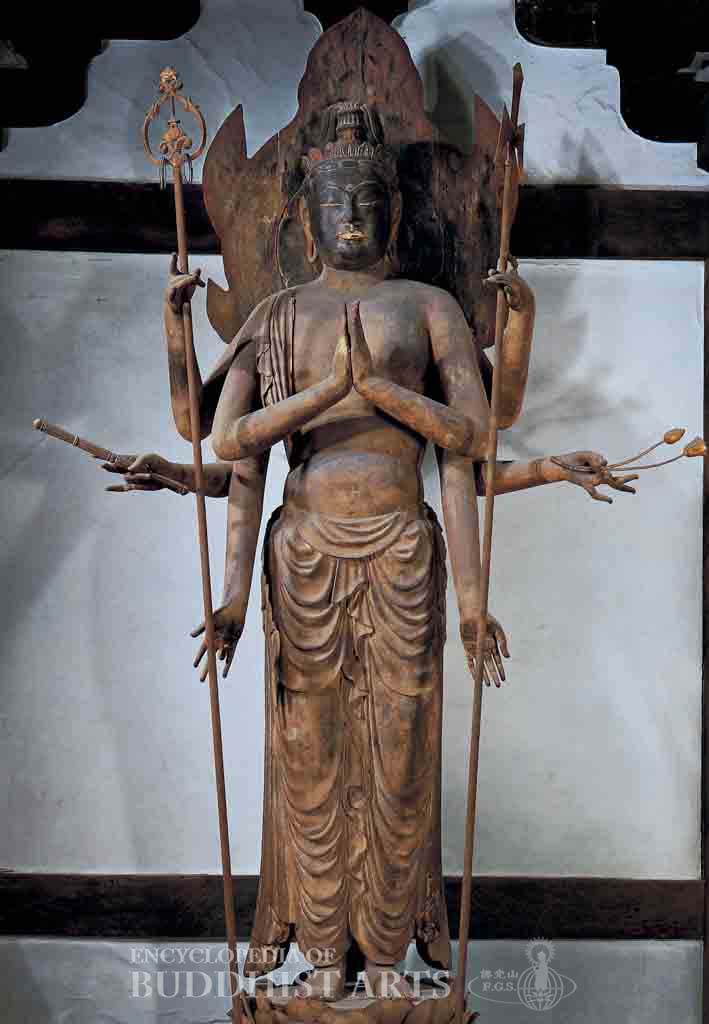
Koryuji Temple: Amoghapasa Avalokitesvara
Cypress wood
Koryuji Temple: Amoghapasa Avalokitesvara
JAPAN, Kyoto; Heian period
Temple records suggest that the statue dates to the beginning of the Heian period (794–1185). It was enshrined in the temple’s lecture hall, but is now kept at the Treasure Hall. It is carved from a piece of cypress wood, while the limbs of the upper body and implements were attached later. The rim of the nimbus is carved with flames and on its surface are bas-reliefs of eight-petaled lotus flowers. This or the paint applied to it may be of a later date. The work was listed as a National Treasure in 1952.
The figure has hair arranged about a headpiece and wears a multi-leaf crown. The image’s principal hands are joined before the chest in anjali (reverence) mudra. Held in the other three pairs of hands, there is a monk’s staff, a halberd, a baton, and some lotus flowers. The lower pair of hands are in the varada (wish-granting) mudra. The pattern of folds in the slightly clinging skirt are striking, especially the ruffled effect around the central section.
For more details, go to the Encyclopedia of Buddhist Arts: Sculpture G-M, page 558.
Cite this article:
author = Hsingyun and Youheng and Lovelock, Yann and Chou, Yuan and Huntington, Susan and Edson, Gary and Neather, Robert,
booktitle = {Encyclopedia of Buddhist Arts: Sculpture G-M},
pages = 558,
title = {{Koryuji Temple: Amoghapasa Avalokitesvara}},
volume = 11,
year = {2016}}