
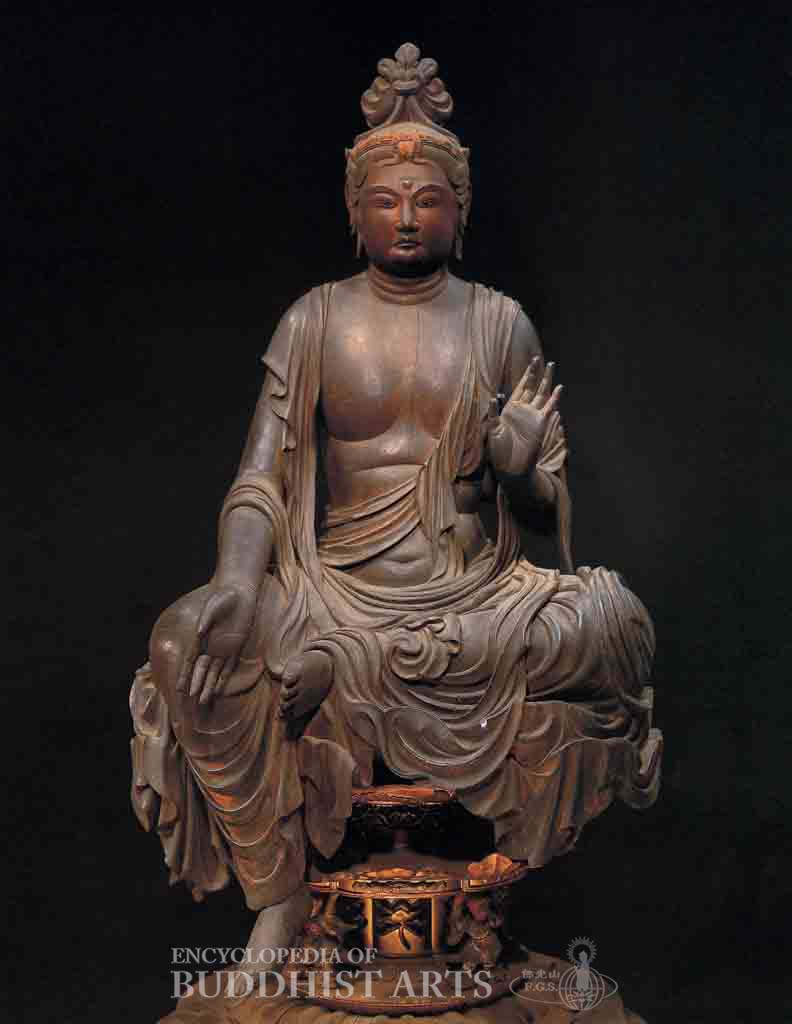
Hobodaiin Temple Main Hall: Seated Bodhisattva
Cypress wood
Hobodaiin Temple Main Hall: Seated Bodhisattva
JAPAN, Kyoto; Heian period
The statue is supposed to be of Cintamanicakra Avalokitesvara according to temple records. The figure measures 86.7 cm. Apart from the forearms, legs and feet, the figure was sculpted from a single piece of cypress wood. Other than the lips that are touched with vermilion, the whole sculpture exhibits the meticulous texturing of the original wood grain. The form may be influenced by Chinese sandalwood sculptures, and one school of thought attributes the work to Chinese sculptors during the early 9th century of the Heian period. Another possibility is that the statue is an image of Akasagarbha Bodhisattva produced by Master Kukai after returning from China. The sculpture became a National Treasure in 1957.
The figure’s left hand is raised in abhaya (fearlessness) mudra while the right hand opens in varada (wish-granting) mudra. The Bodhisattva is seated in the relaxation posture with the right leg overhanging the lotus base. The hair is arranged into a flower-shaped topknot and the head is crowned with a floral circlet. The urna and pupils are separately inlaid with crystal and black stones and the eyebrows are sharply defined, giving the eyes focus. Stoles drape the upper body, crisscrossing at the back and extending over the knees and arms to fall loosely over the seat.
For more details, go to the Encyclopedia of Buddhist Arts: Sculpture G-M, page 430.
Cite this article:
author = Hsingyun and Youheng and Lovelock, Yann and Chou, Yuan and Huntington, Susan and Edson, Gary and Neather, Robert,
booktitle = {Encyclopedia of Buddhist Arts: Sculpture G-M},
pages = 430,
title = {{Hobodaiin Temple Main Hall: Seated Bodhisattva}},
volume = 11,
year = {2016}}