
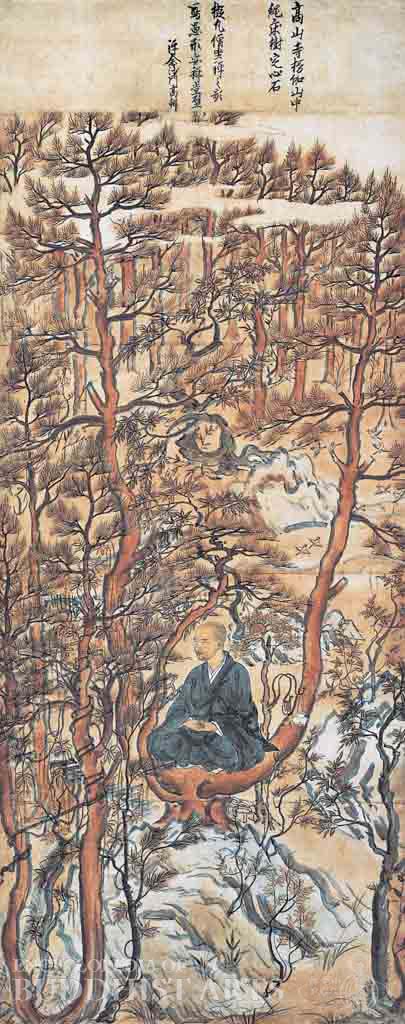
Kozanji Temple: Master Myoe
Ink and color on paper
Kozanji Temple: Master Myoe
JAPAN, Kyoto; Kamakura period
This painting of Master Myoe sitting on a tree meditating is thought to have been painted in the 13th century by one of his disciples, Enichibo Jonin. Myoe, born Koben, was born to a distinguished family in Kii (present day Wakayama and Mie). He lost his parents as a child and lived with his uncle Jogaku, who was a monk at Jingoji Temple in Mount Takao. He renounced at the age of 16 at Todaiji Temple in Nara, and studied both Shingon and Kegon school teachings. Myoe led a rigorous life of religious training in Yuasa Bay. During this time, it was said that Myoe attempted to go to India for a pilgraimage, but the deities enshrined in Kasuga Shrine prohibited him from embarking on this trip.
In 1206, the retired Emperor Go-Toba (reigned 1183–1198) granted him land in Toganoo that belonged to Jingoji Temple, where he built Kozanji Temple, where this painting is kept. Myoe was known to possess a benevolent character and skills of calligraphy. He was also keen in cultivating tea, which he did in the hills of Toganoo after Eisai, a Zen monk gave him some tea seedlings. He composed a book titled Yume no ki, which is a record of his dreams for forty years.
Myoe meditates with his eyes closed, sitting upon a curved pine tree. There is a pair of wooden sandals on the ground behind Myoe, and a white incense burner hangs from a tree beside him. The trunks of the pine trees and the rocks are outlined with thick black lines. Fine strokes are used to paint the pine needles and Myoe’s facial features. Small sections of rock are left blank, but the rest of the painting is filled with lines and color. The inscription at the top was written by Myoe himself, describing his meditation. The painting was listed as a National Treasure in 1952.
For more details, go to the Encyclopedia of Buddhist Arts: Painting I-O, page 453.
Cite this article:
author = Hsingyun and Youheng and Youlu and Wilson, Graham and Manho and Mankuang and Huntington, Susan,
booktitle = {Encyclopedia of Buddhist Arts: Painting I-O},
pages = 453,
title = {{Kozanji Temple: Master Myoe}},
volume = 15,
year = {2016}}