
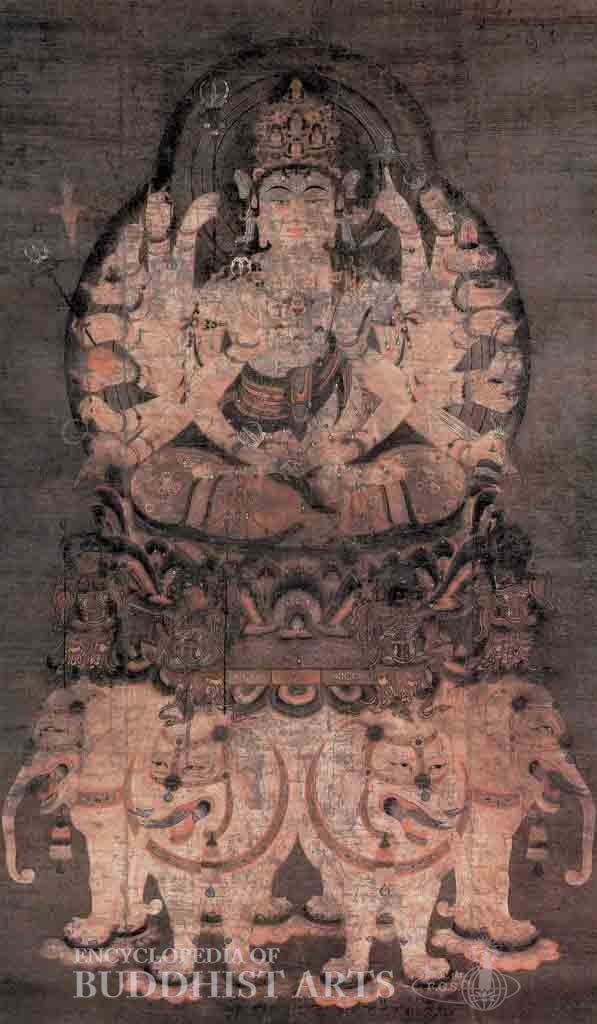
Jikoji Temple: Twenty-Armed Samantabhadra
Ink and color on silk
Jikoji Temple: Twenty-Armed Samantabhadra
JAPAN, Hiroshima, Onomichi; Heian period
An inscription on the back of this painting of Samantabhadra Bodhisattva in “life-prolonging form” states that it was made in 1153 as an offering in prayer for longevity, making it the oldest Japanese depiction of this form of Samantabhadra. It was listed as a National Treasure in 1975.
Wearing a crown decorated with small images of the Five Dhyani Buddhas, Samantabhadra Bodhisattva sits in full lotus position on a lotus throne carried by four white elephants. The Bodhisattva has partially closed eyes that gaze peacefully at the viewer. Two hands are held in front of the chest forming mudras, two hands rest on the knees, and the rest of the 20 hands are spread out symmetrically around the body holding objects. The Four Heavenly Kings, portrayed according to descriptions in the Dharani Samuccaya Sutra, stand upon the heads of the elephants.
The Bodhisattva is painted white, with the facial features and arms traced in red. Blended colors and floral patterns are applied to the dhoti and the stole. This painting is one of the earliest known examples of the new style of Vajrayana Buddhist art that emerged in the second half of the 12th century.
For more details, go to the Encyclopedia of Buddhist Arts: Painting I-O, page 385.
Cite this article:
author = Hsingyun and Youheng and Youlu and Wilson, Graham and Manho and Mankuang and Huntington, Susan,
booktitle = {Encyclopedia of Buddhist Arts: Painting I-O},
pages = 385,
title = {{Jikoji Temple: Twenty-Armed Samantabhadra}},
volume = 15,
year = {2016}}