
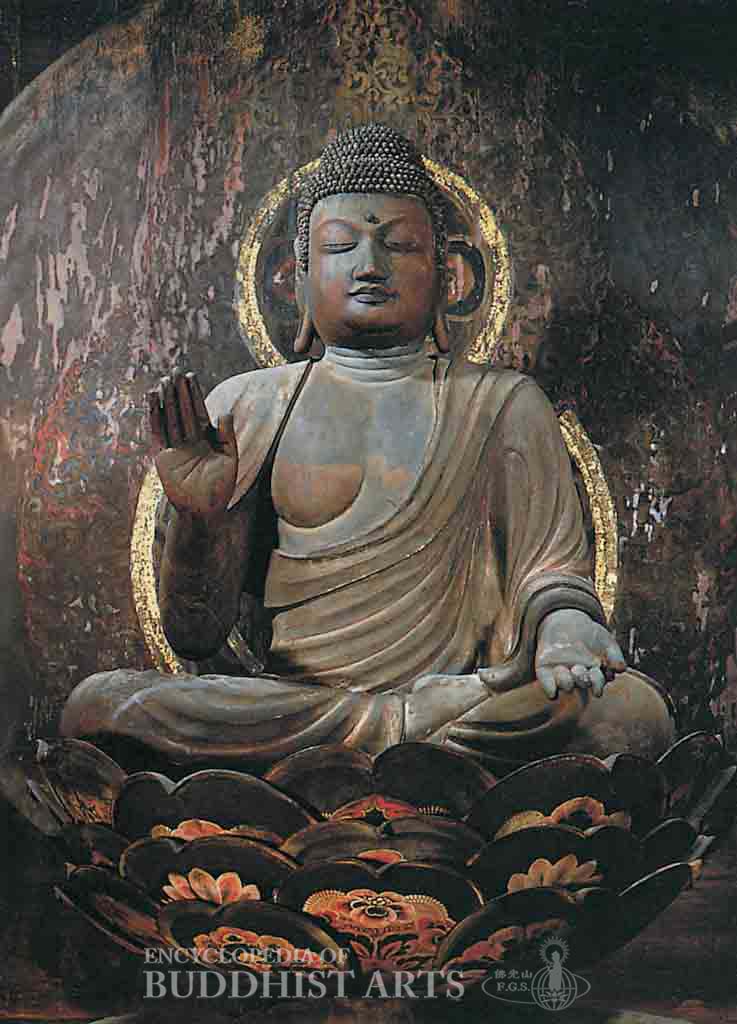
Jisonin Temple Maitreya Hall: Maitreya Buddha
Cypress wood
Jisonin Temple Maitreya Hall: Maitreya Buddha
JAPAN, Wakayama, Ito; Heian period
An inscription found within the robes of the statue states it was completed in 892. Kept hidden until now, the statue is in good condition and was listed as a National Treasure in 1963.
The Buddha’s head, body and legs were carved from a single piece of wood which was then hollowed, while the wrists and robes are later attachments. The figure sits in full lotus position with the right hand raised in abhaya (fearlessness) mudra and the left hand opening in varada (wish-granting) mudra. The eyelids below the urna are only slightly open as if in deep meditation. The monastic robes are carved with large drapery folds. Ocher is painted on the skin areas, while vermilion is applied on the garments. The hems, folds and creases of the robe are painted with lines of gold edging, and the circular aureole and nimbus are simply painted onto the wooden backing. The layered lotus petals of the throne are individually decorated with floral motifs.
For more details, go to the Encyclopedia of Buddhist Arts: Sculpture G-M, page 499.
Cite this article:
author = Hsingyun and Youheng and Lovelock, Yann and Chou, Yuan and Huntington, Susan and Edson, Gary and Neather, Robert,
booktitle = {Encyclopedia of Buddhist Arts: Sculpture G-M},
pages = 499,
title = {{Jisonin Temple Maitreya Hall: Maitreya Buddha}},
volume = 11,
year = {2016}}