
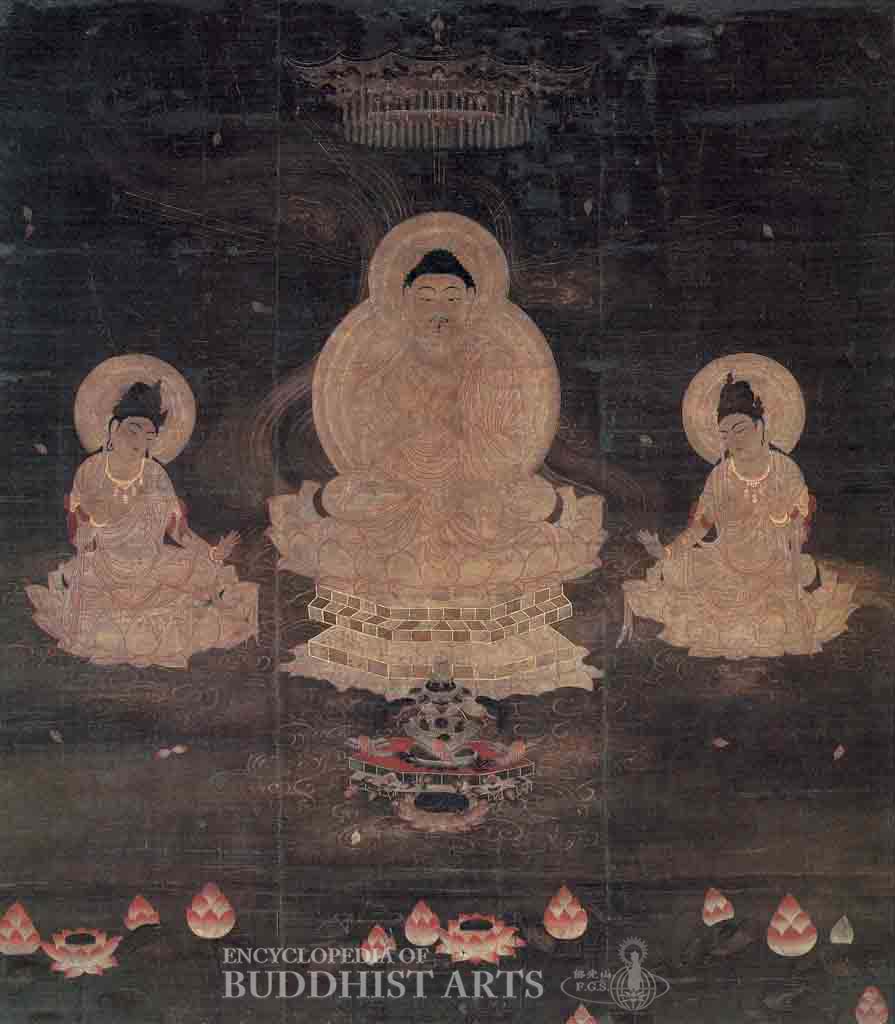
Renge Sanmaiin Temple: Amitabha Buddha Triad
Ink and color on silk
Renge Sanmaiin Temple: Amitabha Buddha Triad
JAPAN, Wakayama, Ito; Kamakura period
According to the inscription on the back, this 12th century painting was a gift from Master Honen, founder of the Japanese Pure Land school, to Master Myohen of Renge Sanmaiin Temple. The Pure Land school flourished on Mount Koya (Tall Plain Mountain) during the late Heian period (794–1185); Renge Sanmaiin Temple was one of many that were built in the area. The picture combines features of traditional Pure Land artworks depicting the Amitabha Buddha Triad with aspects of raigo (welcoming approach) paintings. It was listed as a National Treasure in 1952.
The three golden figures sit on lotus thrones above a pond. The large figure of Amitabha Buddha is on a raised throne in the center, likely forming the Dharmacakra (Dharma wheel) mudra. A faint trail of cloud behind Amitabha suggests that he has arrived from far away. Avalokitesvara and Mahasthamaprapta Bodhisattvas sit beside the Buddha. Below, a gilt bronze vase, an incense burner, and three birds rest on a hexagonal altar supported by a lotus.
For more details, go to the Encyclopedia of Buddhist Arts: Painting P-Z, page 768.
Cite this article:
author = Hsingyun and Youheng and Youlu and Wilson, Graham and Manho and Mankuang and Huntington, Susan,
booktitle = {Encyclopedia of Buddhist Arts: Painting P-Z},
pages = 768,
title = {{Renge Sanmaiin Temple: Amitabha Buddha Triad}},
volume = 16,
year = {2016}}