

Chi Lin Nunnery: Great Hero Hall
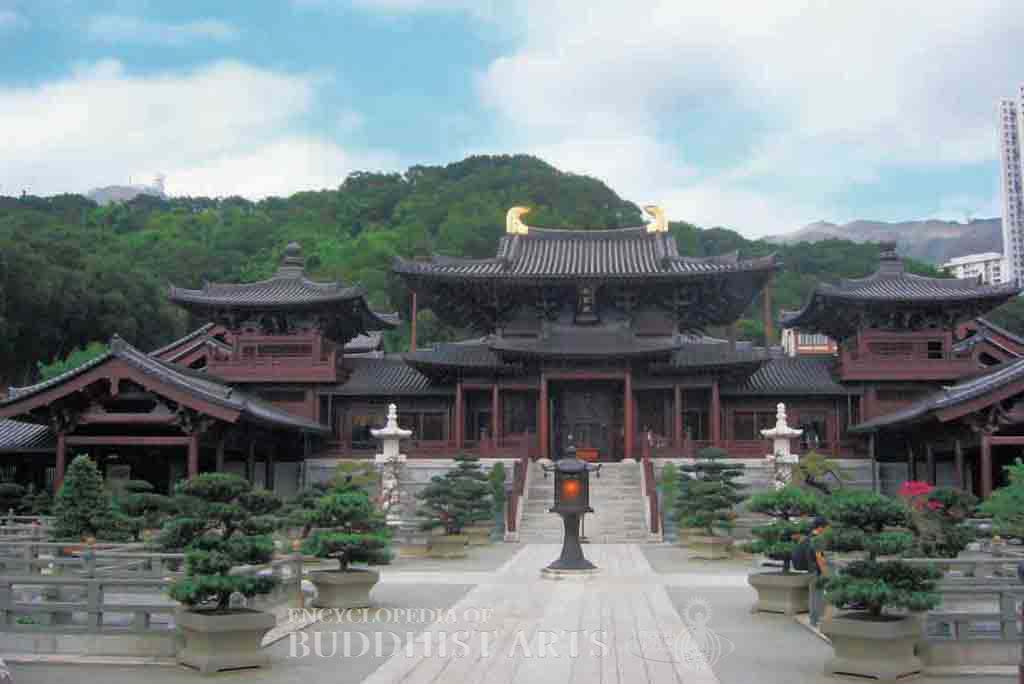
Chi Lin Nunnery: Heavenly King Hall

Chi Lin Nunnery (site layout)
Chi Lin Nunnery
CHINA, Hong Kong
The nunnery is located in Kowloon and is one of the first Buddhist nunneries in Hong Kong. It was established in 1934 by two monks, Gokyat and Waiam. It was reconstructed in 1998 to become the largest Tang-style timber complex in Hong Kong, as well as one of the largest temples in the city.
Facing south, the nunnery occupies 1.7 ha. It has the traditional Chinese seven-structure temple layout complete with three courtyards and three gates. Close to the main temple gate there is the lotus pond. The main buildings along the central axis are the Heavenly King Hall, Great Hero Hall, Dharma Hall, and the sutra repository. Side buildings include the Medicine Buddha Hall, Avalokitesvara Hall, bell and drum towers, reception hall, ancestral hall, and the chanting hall. A square Ten Thousand Buddha Pagoda can be found on a small hill to the northeast of the temple.
The three-bay by six-rafter Heavenly King Hall has a double-eave hip-and-gable roof covered in gray tiles. A golden ornament is located at either end of the main ridge. On either side of the Heavenly King Hall there are the bell and drum towers, which are linked by covered walkways. Both towers have pyramidal roofs. The One-Hall-Two-Tower layout was modeled after the illustration of the Amitayurdhyana Sutra in Mogao Cave 172, which was made during the High Tang period (712–756). The five-by-four bay Great Hero Hall has a single-eave hip roof covered in gray tiles. At either end of the main ridge there is a golden ornament. The roof has a gradual slope with extended eaves.
The nunnery also includes a cultural center, a library, a secondary school, an orphanage, and a senior home. It is one of the earliest temples to propagate the Dharma through providing social services alongside its religious, cultural, and educational activities.
For more details, go to the Encyclopedia of Buddhist Arts: Architecture A-F, page 145.
Cite this article:
author = Hsingyun and Youheng and Johnson, Peter and Mankuang and Lancaster, Lewis,
booktitle = {Encyclopedia of Buddhist Arts: Architecture A-F},
pages = 145,
title = {{Chi Lin Nunnery}},
volume = 1,
year = {2016}}