
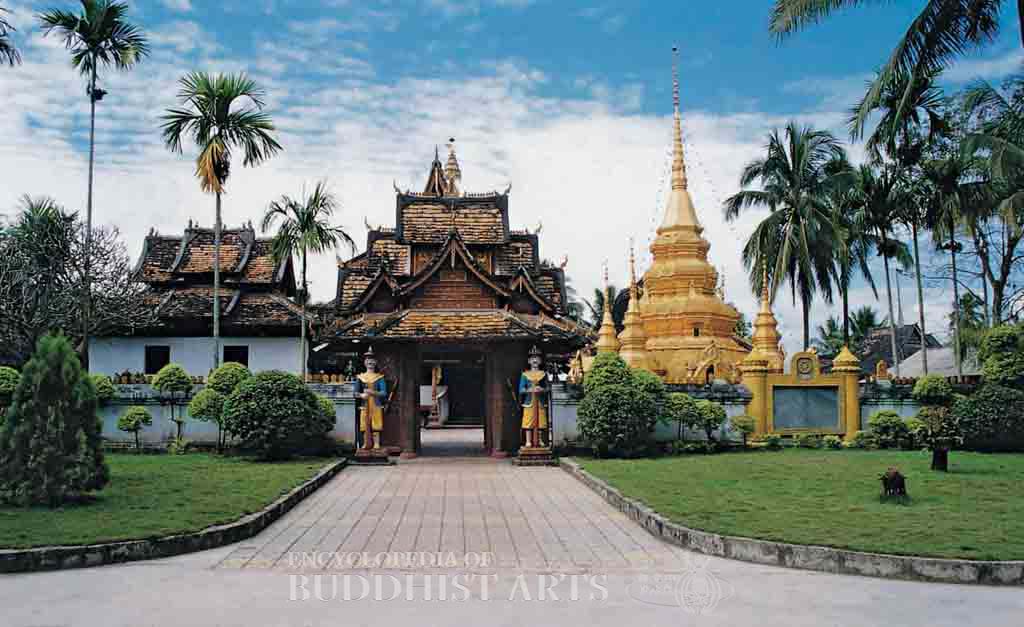
Walong Temple
Walong Temple
CHINA, Yunnan, Jinghong
Walong in Dai means Great Buddha Temple. It was constructed during the early Ming dynasty (1368–1644) in the place where the feudal lord once offered his respects to the Buddha. As the feudal lord is the highest ranking official in the area of Sipsongpanna, Walong became the highest ranking temple in the area. It is also one of the largest Theravadan temples in China.
The main structures within the temple are the temple gate, covered walkway, Buddha hall, stupa, monastic quarters, and the assembly hall. The Buddha hall is built on a 3.6 m high base and has a triple-eave hip-and-gable roof. The pitched roof is divided into overlapping sections. There are a total of 29 ridges which are all decorated with stylized nagas. A covered walkway links the temple gate to the Buddha hall. It is unique since the height of the walkway varies as it progresses. The stupa stands on a high, octagonal, multi-tier, Sumeru base. The spire base is shaped like a bell, and topped by 13 stacked rings. The finial is exceptionally high.
For more details, go to the Encyclopedia of Buddhist Arts: Architecture T-Z, page 1171.
Cite this article:
author = Hsingyun and Youheng and Johnson, Peter and Mankuang and Lancaster, Lewis,
booktitle = {Encyclopedia of Buddhist Arts: Architecture T-Z},
pages = 1171,
title = {{Walong Temple}},
volume = 4,
year = {2016}}