
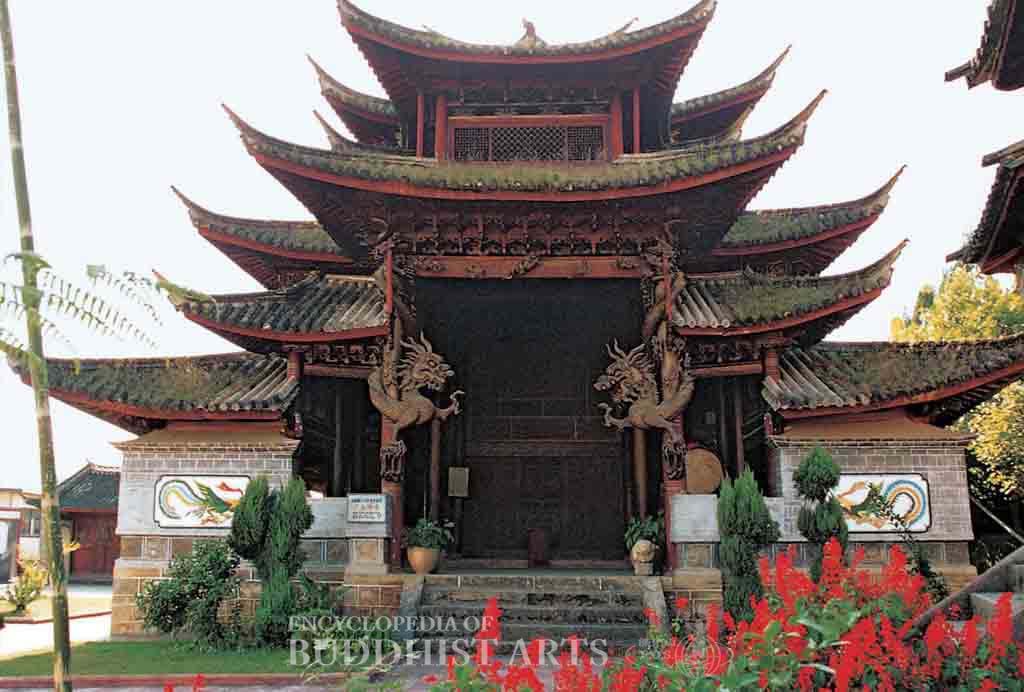
Guangyun Temple: Buddha Hall
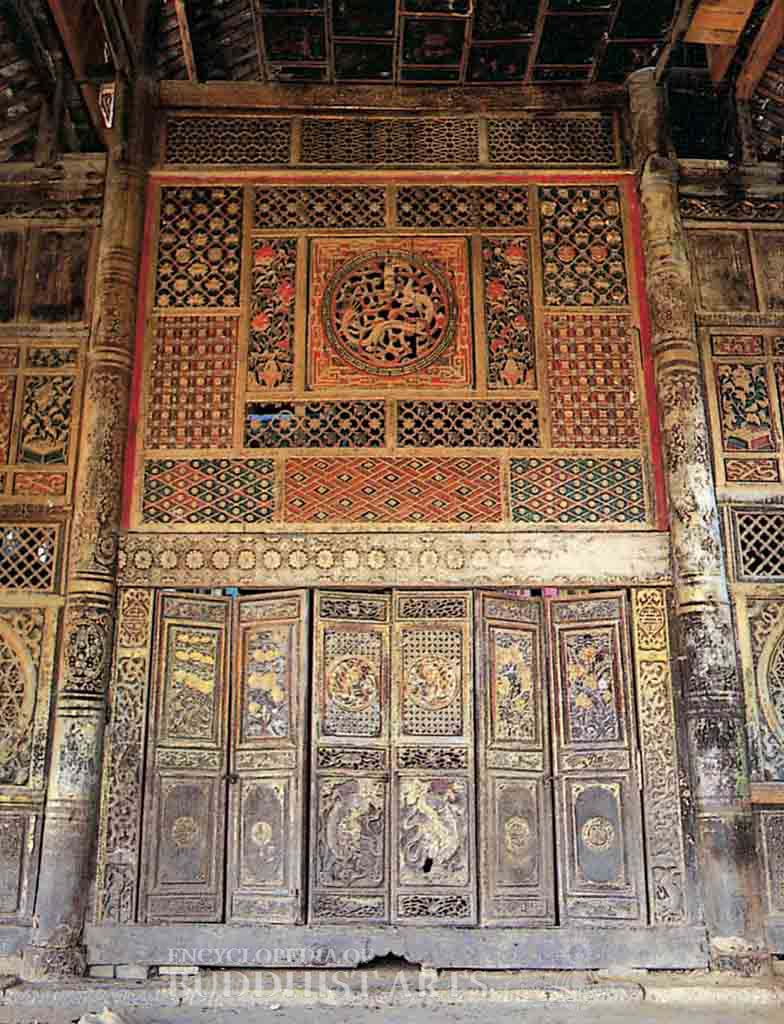
Guangyun Temple: Buddha Hall (interior)
Guangyun Temple
CHINA, Yunnan, Lincang
Guangyun means Vast Consent. It was built in 1828 during the Qing dynasty but only a Buddha hall now remains. It was famous for its architecture and murals. The bracket sets and decorated ceiling are all in Chinese style but its layout and murals are in Dai style. It was listed as a National Cultural Heritage Site in 1988.
The Buddha hall has triple eaves, together with additional eaves at the sides, and a hip-and-gable roof. A veranda once surrounded the building but recent renovation added some walls, enclosing the veranda and concealing the rest of the building. The portico has double eaves and the columns have exquisitely carved giant wooden dragons entwined around them. All the doors and windows are decorated with openwork carvings of fish, dragons, landscapes, figures, and geometric patterns. These carvings are painted red with embellishments in gold. The beams feature floral patterns and images of donors painted in gold.
The Buddha hall faces west and is deeper than it is wide, which is clearly different from the Chinese style. The woodwork was created by the Bai clan of craftsmen from Jianchuan. The hall houses ten murals, one of which depicts the important investiture of the local chieftain of the Dai by the Qing court. It provides valuable research material for the study of local history, people, religion, and culture.
For more details, go to the Encyclopedia of Buddhist Arts: Architecture G-L, page 403.
Cite this article:
author = Hsingyun and Youheng and Johnson, Peter and Mankuang and Lancaster, Lewis,
booktitle = {Encyclopedia of Buddhist Arts: Architecture G-L},
pages = 403,
title = {{Guangyun Temple}},
volume = 2,
year = {2016}}