
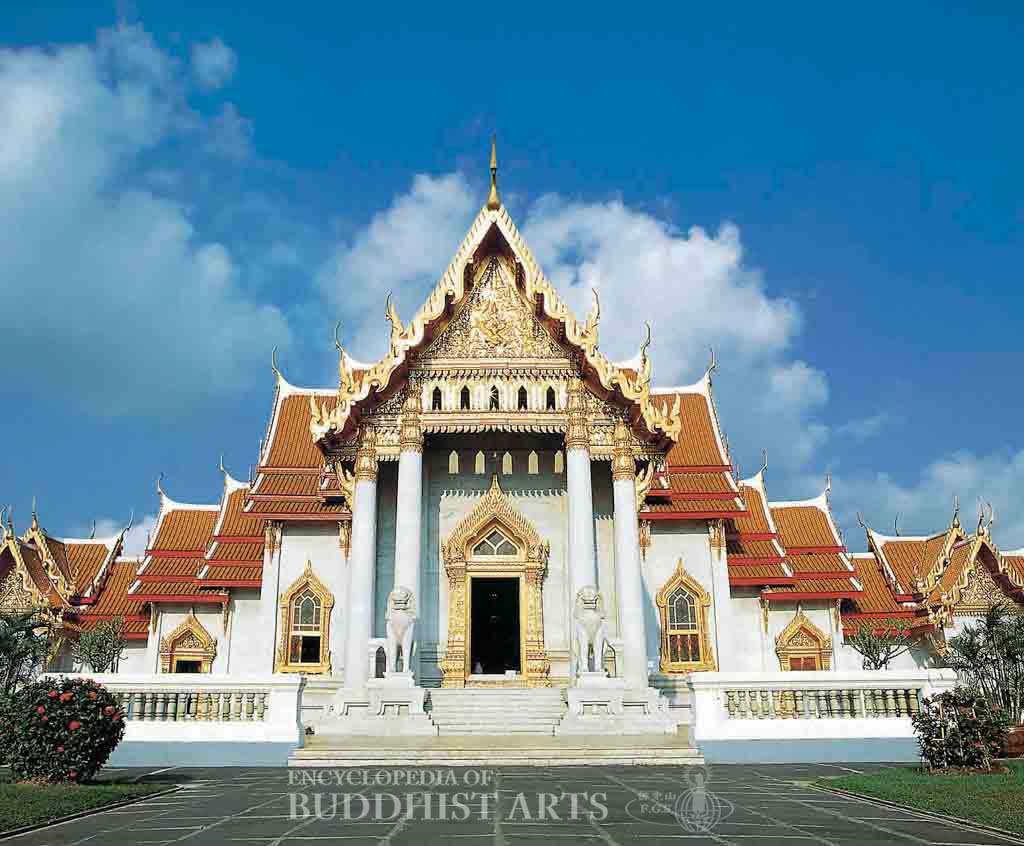
Wat Benchamabophit
Wat Benchamabophit
THAILAND, Bangkok
Wat Benchamabophit means Temple of the Fifth King. It is also spelled Wat Benjamabophit and it is popularly known as the Marble Temple, because its walls are covered with marble from Italy. It is one of the most beautiful temples in Thailand and is featured on the back of the five-baht coin. It is a first class royal temple. The temple was previously called Wat Lem and dates to the late Ayutthaya period (1350–1767). In 1827 it served as the military headquarters for an expeditionary force led by a son of King Rama II (reigned 1809–1824). After the war ended, the prince and his four brothers built a stupa at the temple. Later King Rama IV (reigned 1851–1868) renamed the temple Wat Benchabophit (Five Princes Temple) in honor of the five brothers. In 1899 King Rama V (reigned 1868–1910) appointed his younger brother, well-known architect Prince Naris, to build a new ordination hall with the help of an Italian architect, Hercules Manfredi. The king gave the temple its current name, and the present layout results from this extension.
The main feature of this temple is the ordination hall. It is erected on a cruciform layout and has a roof with multiple tiers and numerous sections. It is constructed using architectural styles from a combination of cultures. The exterior walls were built in Carrara marble imported from Italy. The roof is laid with golden glazed tiles in Chinese style. The lattice windows are made from Victorian-style stained glass, in the manner of European church windows, but configured in traditional Thai style floral patterns. The stone lions guarding the main gate are Khmer in style. There is a gallery which is lined with over 50 Buddha images forming various postures and mudras. The statues represent styles from different times, including the Dvaravati, Lopburi, Sukhothai, and Ayutthaya periods. Inside the ordination hall, there is a 3 m high Buddha statue named Phra Buddha Chinnarat. The statue is modeled after the original Phra Buddha Chinarat from Wat Phra Sri Rattana Mahathat in Phitsanulok.
For more details, go to the Encyclopedia of Buddhist Arts: Architecture T-Z, page 1183.
Cite this article:
author = Hsingyun and Youheng and Johnson, Peter and Mankuang and Lancaster, Lewis,
booktitle = {Encyclopedia of Buddhist Arts: Architecture T-Z},
pages = 1183,
title = {{Wat Benchamabophit}},
volume = 4,
year = {2016}}