
Fo Guang Shan Malaysia
Fo Guang Shan Malaysia
MALAYSIA, Selangor, Kuala Langat
The temple is also known as Persatuan Kebajikan Agama Buddha Selangor or Dong Zen (East Chan) Temple, and it is the headquarters of the Malaysian branch temples of Fo Guang Shan. When Master Hsing Yun went to Malaysia to propagate the Dharma in 1986, Guo Jianfeng donated 1 ha of land for temple development. Construction of the temple began in 1989 and was completed in 1996, together with the establishment of Dong Zen Institute of Buddhist Studies.
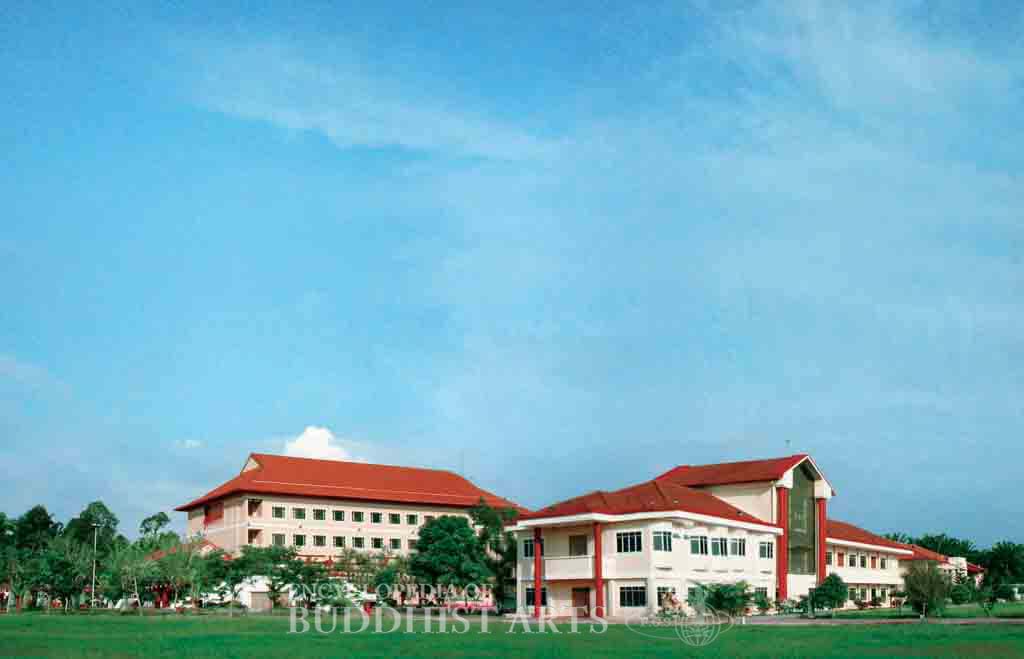
The temple occupies an area of 8.1 ha. The buildings situated on the central axis include the main gate, Eighteen Arhats and Great Hero Hall. To the east are the Dong Zen Institute of Buddhist Studies, Fo Guang Yuan Art Gallery, Lumbini Garden, and Thirty-Three Manifestations of Avalokitesvara. To the west are the Cultivation Center and Reception Hall.
The two-story Great Hero Hall has a single-eave hip roof with a projecting gable roof at the front. The Cultivation Center has four stories and contains a meditation hall, dining hall, lecture hall, and auditorium. In front of the Dong Zen Institute of Buddhist Studies there is a two-story building with the Fo Guang Yuan Art Gallery on the first story and the sutra calligraphy hall on the second.
The temple was given an award by the Ministry of Culture, Arts, and Tourism as a religious landmark site in 1999, and another award by the Selangor government in 2003.
For more details, go to the Encyclopedia of Buddhist Arts: Architecture A-F, page 321.
Cite this article:
author = Hsingyun and Youheng and Johnson, Peter and Mankuang and Lancaster, Lewis,
booktitle = {Encyclopedia of Buddhist Arts: Architecture A-F},
pages = 321,
title = {{Fo Guang Shan Malaysia}},
volume = 1,
year = {2016}}