
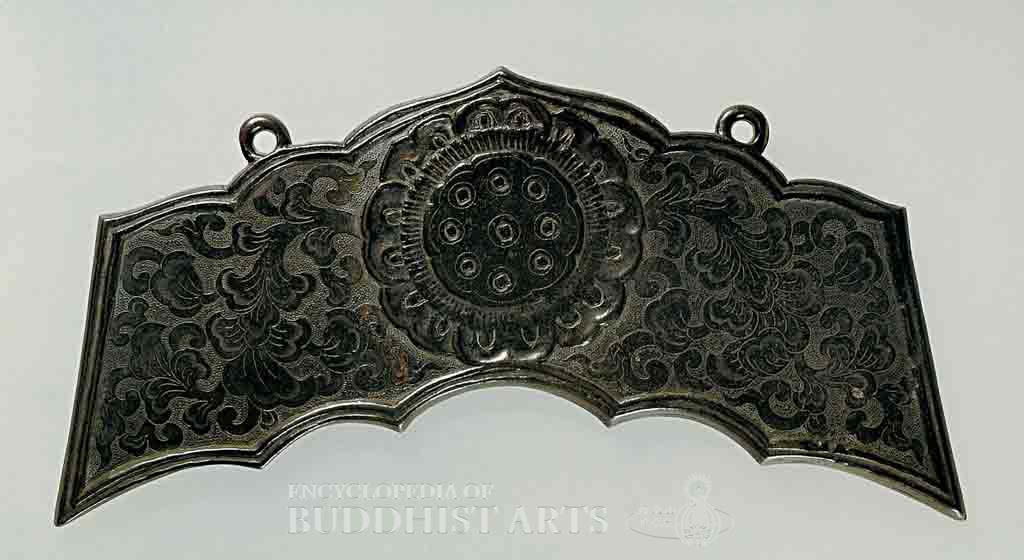
Takidanji Temple: Gong
Gilt bronze
Takidanji Temple: Gong
JAPAN, Sakai, Fukui; Heian period
Created in the late Heian period, this ritual gong was listed as a National Treasure in 1953.
Made of gilt bronze, it forms a graceful curve, which is enhanced by the curves at the top and bottom. It measures 9.5 cm high and 24 cm wide at the top; the bottom is 27 cm wide and it weighs just over 1 kg. The raised center boss has a diameter of 8 cm and contains lotus seeds. It is surrounded by eight large lotus petals. The surface is engraved with a hosoge flower design, which consists of a combination of peony, lotus, floral, and scroll leaf patterns.
Beginning in the Heian period, members of the Japanese nobility became fond of elegantly styled artwork, which influenced the design of Buddhist artworks. The hosoge design was introduced in the 8th century and developed into its distinctive form during the Heian period. This ritual gong is a fine example of the application of this unique design.
For more details, go to the Encyclopedia of Buddhist Arts: Artifacts, page 328.
Cite this article:
author = Hsingyun and Youheng and Youji and Pokorski, Stefanie and Mankuang and Fan, Wen,
booktitle = {Encyclopedia of Buddhist Arts: Artifacts },
pages = 328,
title = {{Takidanji Temple: Gong}},
volume = 18,
year = {2016}}