
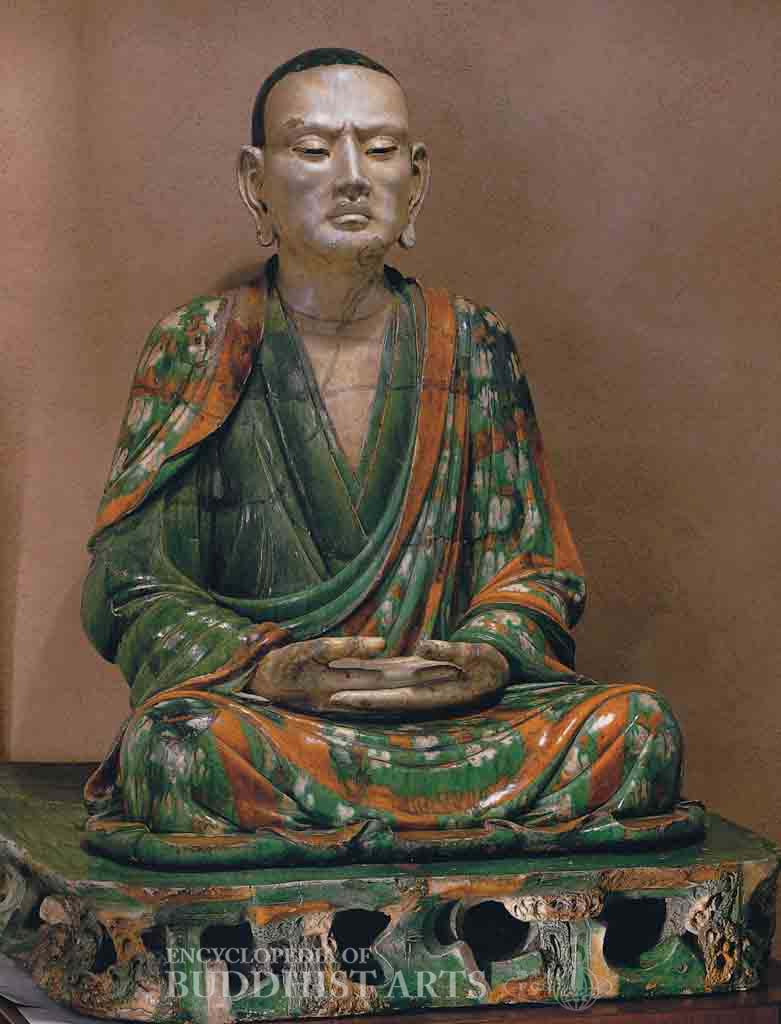
Emei Temple Bafowa Cave: Arhat
Stoneware
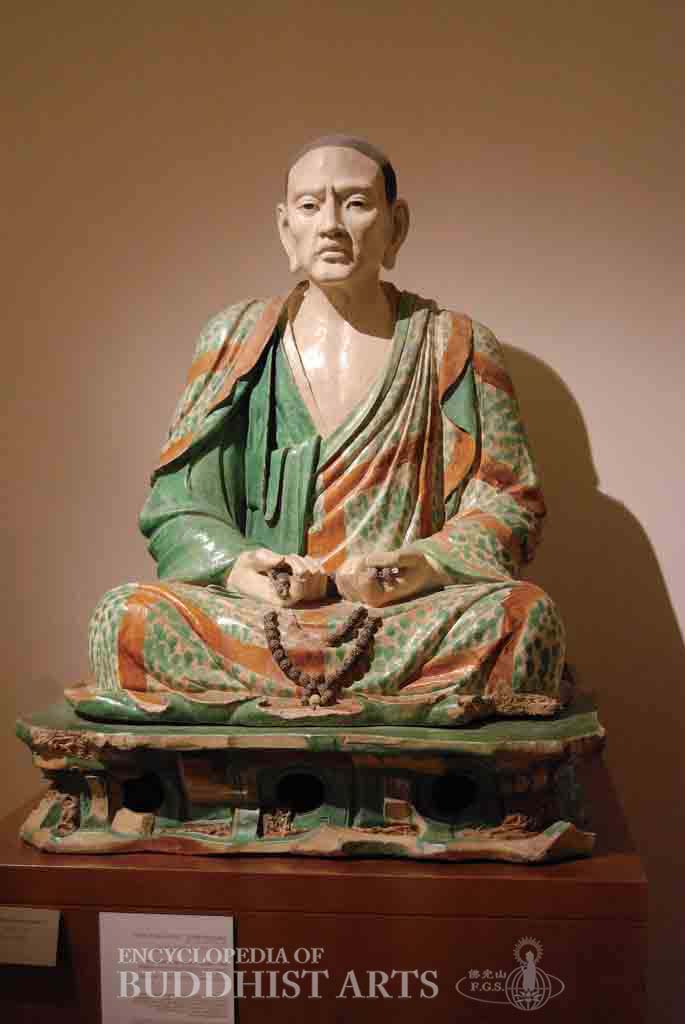
Emei Temple Bafowa Cave: Arhat
Stoneware

Emei Temple Bafowa Cave: Arhat
Stoneware
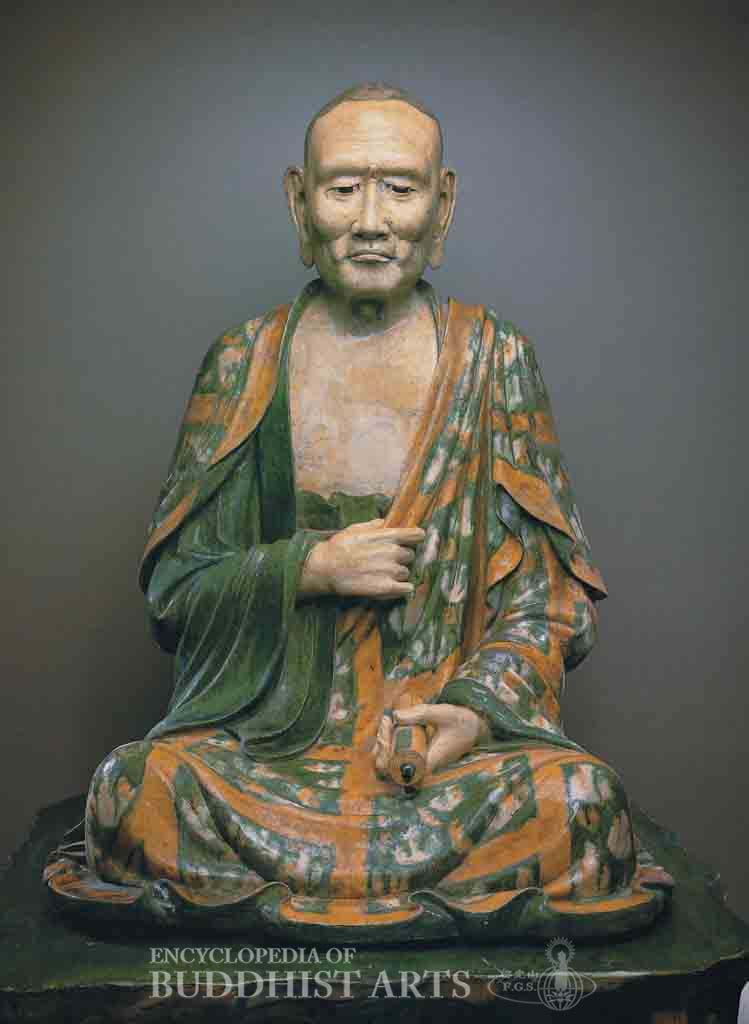
Emei Temple Bafowa Cave: Arhat
Stoneware
Emei Temple Bafowa Cave: Arhats
CHINA, Hebei, Baoding; Liao dynasty
These exceptionally fine, life-sized stoneware statues of a group of Arhats were discovered in a cave in 1913, along with several large fragments. The statues were soon dispersed, eventually finding their way into European and North American museums, and a Japanese collection. Only ten are known; one of these is damaged and others have been restored. There may originally have been sixteen or eighteen but, even incomplete, the quality of their workmanship is regarded as making them among the most important groups of ceramic sculpture in the world.
They were produced by the tri-color technique. Because of their exceptional size, the figures had iron rods inserted internally before firing to support the structure. Their openwork bases were made separately and conventionally represent the mountain rocks on which the Arhats sat meditating in their quest for enlightenment.
The names and attributes of these Arhats vary. Of the figures shown here, only the statue from the Guimet Museum has been tentatively identified as Tamrabhadra. His head is raised and held slightly to one side as he sits cross-legged, absorbed by the heavy prayer beads grasped in his hands. His stippled outer robe has been stitched in the field pattern enjoined on monks by the Buddha, but the brown color indicating this is also used cunningly to show the way that the material conforms to the shape of the body.
The Arhat from the Nelson-Atkins Museum is quite similar, but the head is raised more extremely and the Arhat wears a cross-necked inner robe below the outer. The hands are held in dhyana (meditation) mudra, with the right hand above the left; the thumbs do not touch on account of the unusually long fingers which appear to be all of an equal size. The expressive face depicts him in single-pointed concentration, as indicated by the hooded eyes, drawn brows, and downturned mouth in which, according to traditional meditation instructions, the tongue is pressed against the palate.
Though the features of the Arhat kept in the British Museum are much the same, the details of the robes and the way in which they are worn are different. The head gazes straight forward and the hands are clasped about a fold of the outer robe rather than held in a mudra.
The Metropolitan Museum possesses two Arhat figures, of which the older is illustrated here. The face is hollowed, while the skin of the neck and hands is thinly stretched over the bones beneath. The right hand steadies the loose hem of the outer robe while the left hand holds a sutra scroll in the lap. The individualized faces of all these figures have led some to speculate that their models were eminent monks of the time.
There are similarities with Tang dynasty (618–907) sets of Arhat figures, but scientific tests and the lively details indicate that these are a product of the Liao dynasty (907–1125) or even the succeeding Jin dynasty (1115–1234).
For more details, go to the Encyclopedia of Buddhist Arts: Sculpture A-F, page 314.
Cite this article:
author = Hsingyun and Youheng and Lovelock, Yann and Chou, Yuan and Huntington, Susan and Edson, Gary and Neather, Robert,
booktitle = {Encyclopedia of Buddhist Arts: Sculpture A-F},
pages = 314,
title = {{Emei Temple Bafowa Cave: Arhats}},
volume = 10,
year = {2016}}