
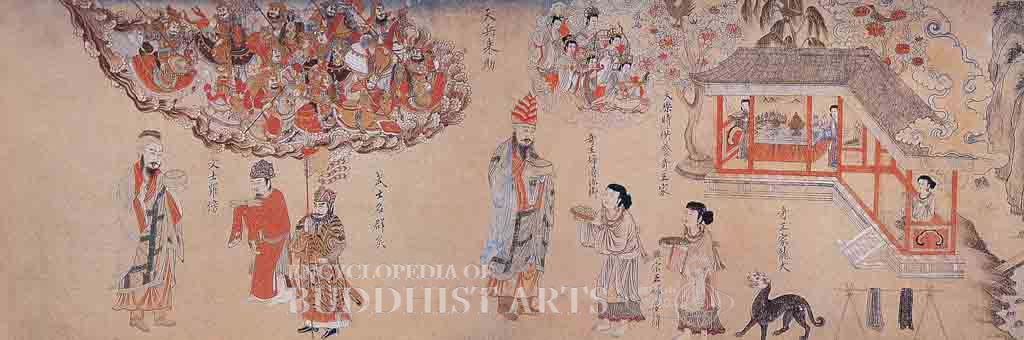
Illustrated History of Nanzhao (detail)
Ink and color on paper
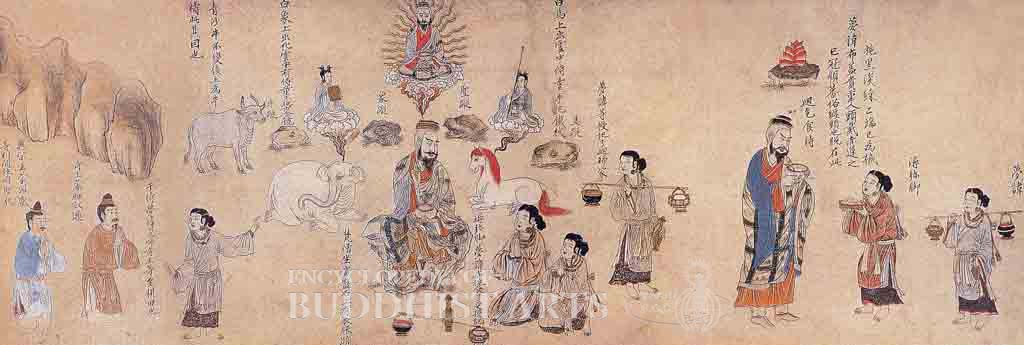
Illustrated History of Nanzhao (detail)
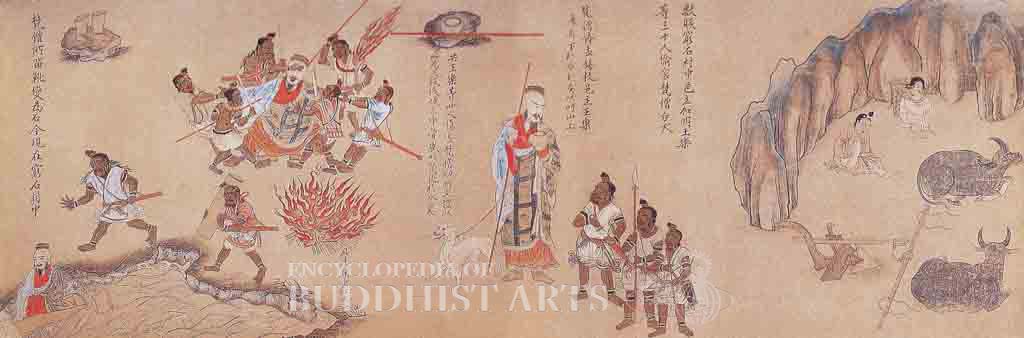
Illustrated History of Nanzhao (detail)
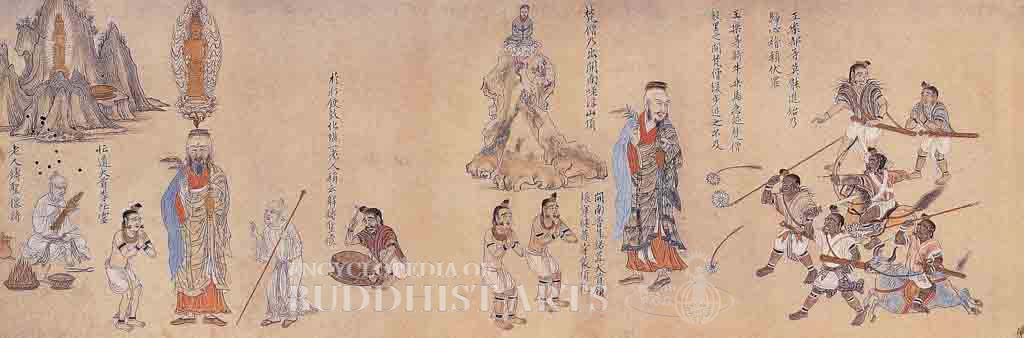
Illustrated History of Nanzhao (detail)
Illustrated History of Nanzhao (detail)
Illustrated History of Nanzhao (detail)
Illustrated History of Nanzhao
CHINA; Nanzhao Kingdom
This scroll, measuring 31.5 cm by 580.2 cm, is divided into two sections. One section is covered with paintings accompanied by short inscriptions, some of which were added by Qing dynasty (1644–1911) art appreciators. This section measures 573 cm in length, taking up most of the scroll. The other section contains written characters in small regular script that provide a detailed explanation of the illustrated content. According to one of the inscriptions dated 899, three officials were instructed to make these illustrations, which were to be based on four historical books. Scholars have deduced that this is a 12th or 13th century copy of the scroll. Nevertheless, the original style appears to be faithfully preserved.
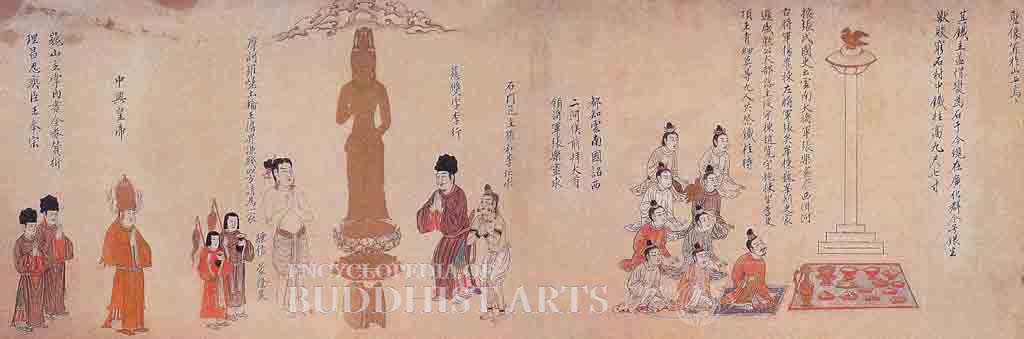
The pictures mainly illustrate legends from the early history of Nanzhao. The stories move from left to right on the scroll, and are divided into 13 sections. The first five illustrations show the first ruler of Nanzhao, King Xinuluo (reigned 649–674) during the days when he sought refuge in Weishan. Before he became king, he was a humble farmer who worked with his son in the fields at the bottom of the mountain. His wife and daughter-in-law were bringing food to the fields one day when they met a monk collecting alms and offered him everything they had. The monk, a manifestation of Avalokitesvara Bodhisattva, appeared as the Bodhisattva and taught the future king the Dharma, leading to Xinuluo’s enlightenment. In the pictures, the monk is shown teaching the Dharma to the king and his family. The sixth to eighth illustrations depict the same monk attempting to teach a group of villagers. Ignorant and enraged, they attack him, cut him to pieces, burn him to ashes, put him into a bamboo container, and throw him into a lake. In the center of the picture, the villagers are shown surrounding the monk and attacking him with weapons. In the bottom left corner, the monk emerges from the container unharmed, baffling his tormentors.
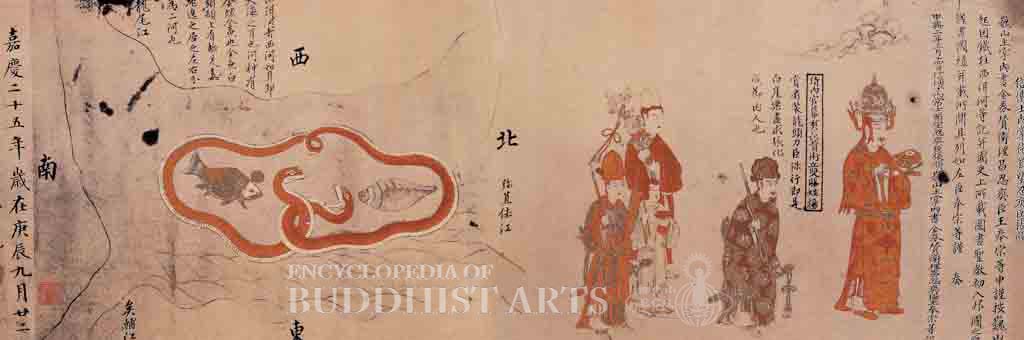
In the ninth image, the monk appears in the form of an elder who declares that he can create a sacred image of Avalokitesvara. The monk holds a vase and a golden image of Ajaya Avalokitesvara is above his head. Villagers attempt to spear and shoot him with arrows, but the shafts turn into flowers in mid-flight. The tenth picture depicts King Luosheng and others worshipping an iron pillar. Nanzhao royalty, tribal leaders, and others are shown joining their palms in reverence below a golden statue of Ajaya Avalokitesvara in the 11th image. The last two illustrations are Emperor Wenwu paying homage to the Buddha, and a symbolic depiction of Er Lake in which two enormous snakes are shown joined head to tail, surrounding a fish and a sea snail.
For more details, go to the Encyclopedia of Buddhist Arts: Painting I-O, page 353.
Cite this article:
author = Hsingyun and Youheng and Youlu and Wilson, Graham and Manho and Mankuang and Huntington, Susan,
booktitle = {Encyclopedia of Buddhist Arts: Painting I-O},
pages = 353,
title = {{Illustrated History of Nanzhao}},
volume = 15,
year = {2016}}