
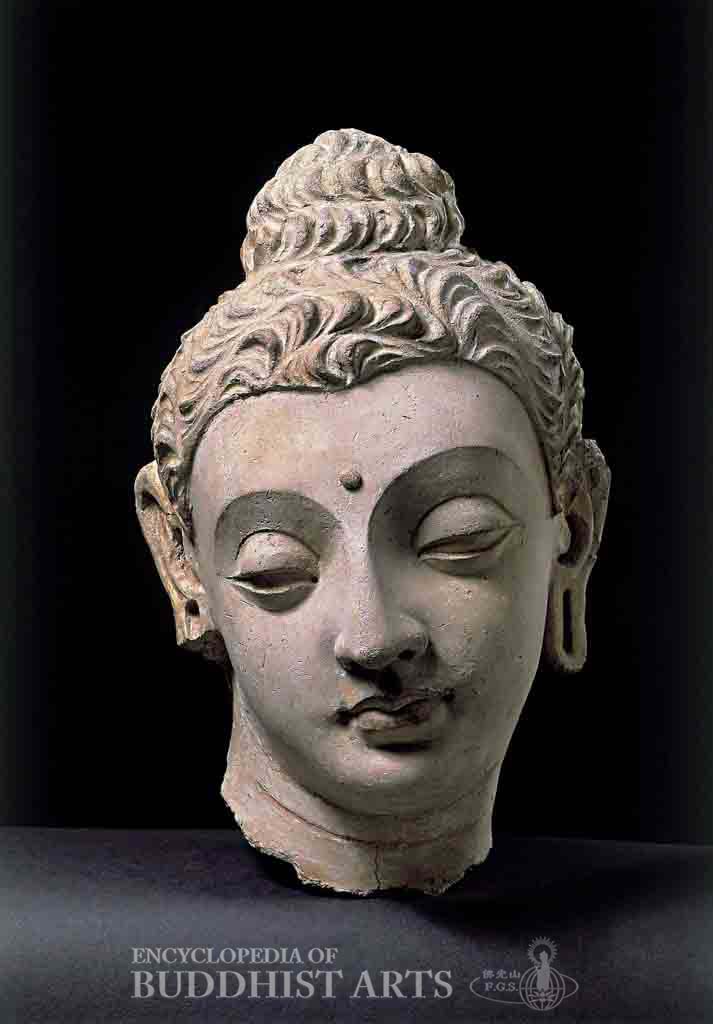
Head of a Buddha
Stucco
Head of a Buddha
AFGHANISTAN
The figure’s oval face has obvious references to the Hellenistic and Roman styles, with large hooded eyes, and wavy hair. However, the high usnisa, the urna and the elongated earlobes are defining characteristics commonly seen in a Buddha. The head is tilted to one side, and combined with the gentle expression, adds to the elegance of the artwork. Some pigment is still visible on the eyelids and hair.
The size of the head suggests that the original sculpture was life-sized. Molds used to create faces like these have been discovered in the Gandhara area, which could be how this statue came about. However, the hair, urna, and other embellishments were later applied by hand. Judging from the style, scholars believe the sculpture was unearthed from Hadda. The back of the head is flattened, suggesting that the head was originally attached to a wall or wearing a nimbus.
For more details, go to the Encyclopedia of Buddhist Arts: Sculpture G-M, page 415.
Cite this article:
author = Hsingyun and Youheng and Lovelock, Yann and Chou, Yuan and Huntington, Susan and Edson, Gary and Neather, Robert,
booktitle = {Encyclopedia of Buddhist Arts: Sculpture G-M},
pages = 415,
title = {{Head of a Buddha}},
volume = 11,
year = {2016}}