

Borobudur Sculptures: Niches
Andesite
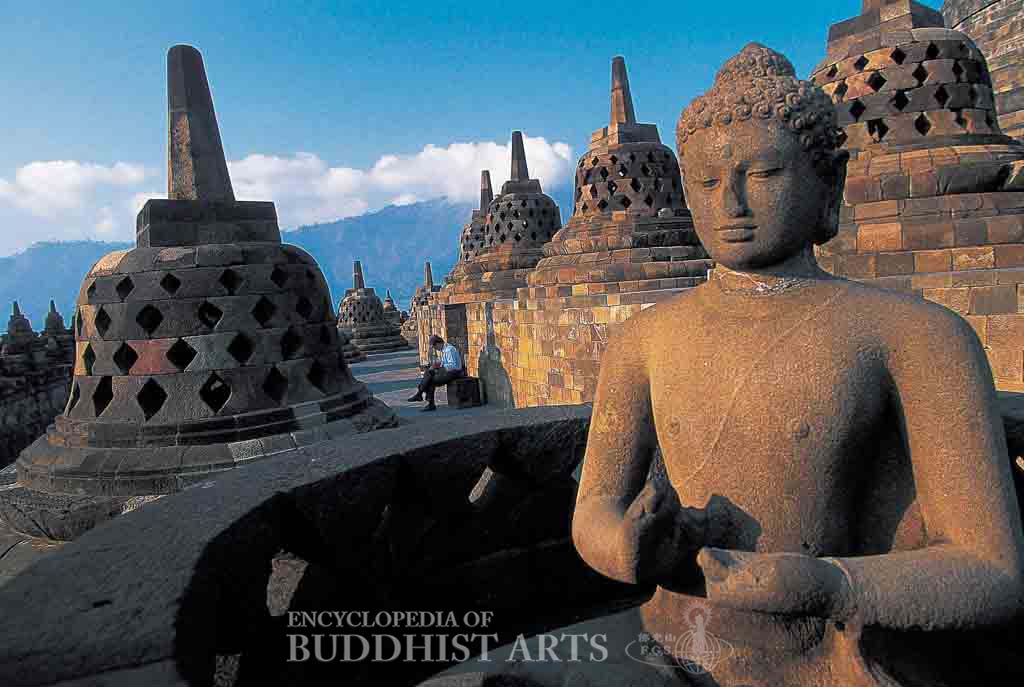
Borobudur Sculptures: Sakyamuni Buddha
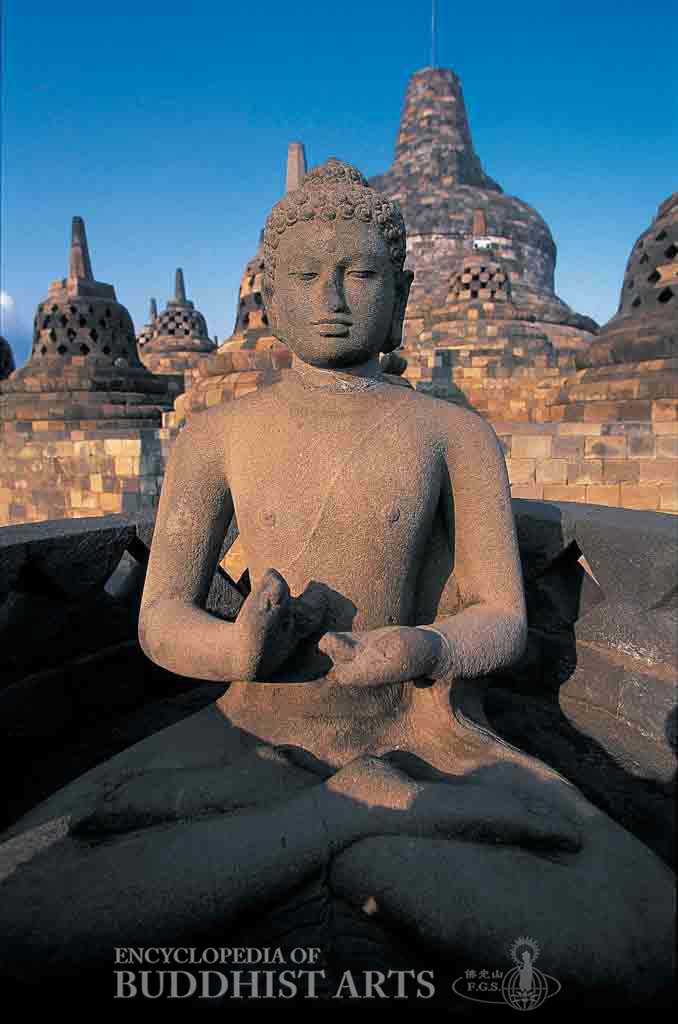
Borobudur Sculptures: Sakyamuni Buddha

Borobudur Sculptures: Niches
Borobudur Sculptures
INDONESIA, Central Java, Magelang
Borobudur is one of the world’s largest Buddhist sites containing 504 Buddha statues. It was listed as a UNESCO World Heritage site in 1991.
Of the 504 statues, 432 are enshrined in niches located along five square terraces, while 72 are in the hollow bell-shape stupas on the three circular terraces. All the Buddhas are similar in appearance. They are depicted sitting in full lotus positions and forming various mudras. The mudras can be classified into six types, each type formed by a different Buddha. The four lower terraces contain four of the Five Dhyani Buddhas in each cardinal direction. They are Amoghapasa Buddhas of the north forming the abhaya (fearlessness) mudra, the Aksobhya Buddhas of the east making the bhumisparsa (earth-touching) mudra, the Ratnasambhava Buddhas of the south forming the varada (wish-granting) mudra, and the Amitabha Buddhas of the west making the dhyana (meditation) mudra. Vairocana Buddhas are on the fifth square terrace and they form the vitarka (teaching) mudra. Finally, on the upper three circular terraces are Sakyamuni Buddhas.
Sakyamuni Buddha is seated in the bell-shape stupa, which has been exposed due to the collapse of the structure. The Buddha has large curls, an urna, and the three lines on the neck that indicates a great person. The monastic robe leaves the right shoulder bare and is indistinct apart from the hemline along the chest, wrists and ankles. The statue has been influenced by the Gupta (circa 320–550) style.
For more details, go to the Encyclopedia of Buddhist Arts: Sculpture A-F, page 178.
Cite this article:
author = Hsingyun and Youheng and Lovelock, Yann and Chou, Yuan and Huntington, Susan and Edson, Gary and Neather, Robert,
booktitle = {Encyclopedia of Buddhist Arts: Sculpture A-F},
pages = 178,
title = {{Borobudur Sculptures}},
volume = 10,
year = {2016}}