
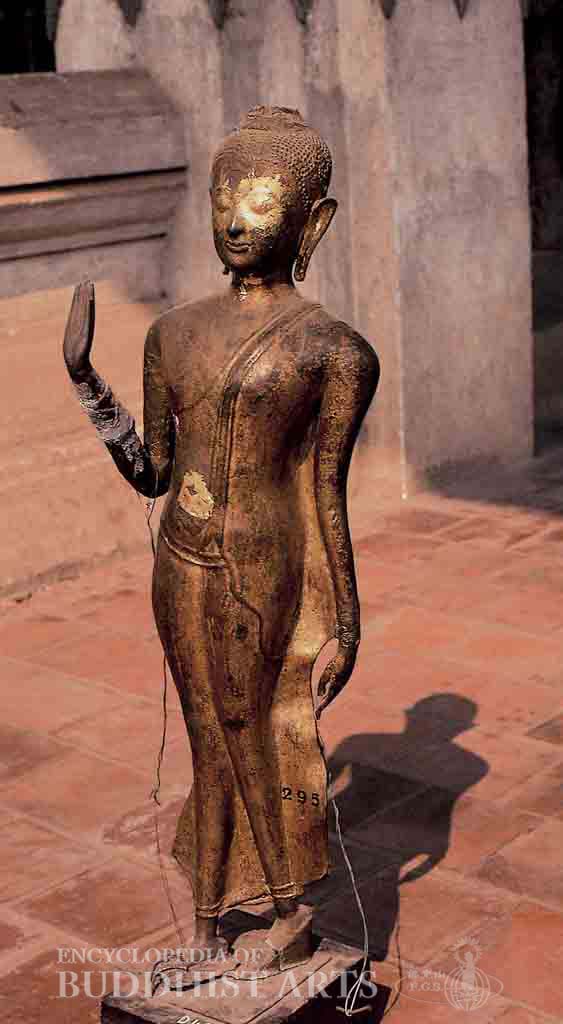
Hor Phra Keo Temple: Walking Buddha
Gilt bronze
Hor Phra Keo Temple: Walking Buddha
LAOS, Vientiane
The temple in which the statue is housed is currently a national museum. King Fa Ngum (reigned 1316–1373) brought Theravada Buddhism from Kampuchea (present day Cambodia) to Laos in the mid-14th century and it became the primary religion until the 19th century. Therefore, Buddhist art, such as those exhibited on stupas, monasteries and statues bore the influence of the Lanna Thai Kingdom (circa 1259–1558).
The serene-looking figure walks forward with the right foot advanced and the right hand raised in abhaya (fearlessness) mudra. Though the chest is broad, the arms and legs are slender. The very thin material of the monastic robe worn over the left shoulder allows the details of the body to show through. The sculpture exhibits a sense of elegance and sculptural style commonly seen in Luang Prabang.
For more details, go to the Encyclopedia of Buddhist Arts: Sculpture G-M, page 440.
Cite this article:
author = Hsingyun and Youheng and Lovelock, Yann and Chou, Yuan and Huntington, Susan and Edson, Gary and Neather, Robert,
booktitle = {Encyclopedia of Buddhist Arts: Sculpture G-M},
pages = 440,
title = {{Hor Phra Keo Temple: Walking Buddha}},
volume = 11,
year = {2016}}