
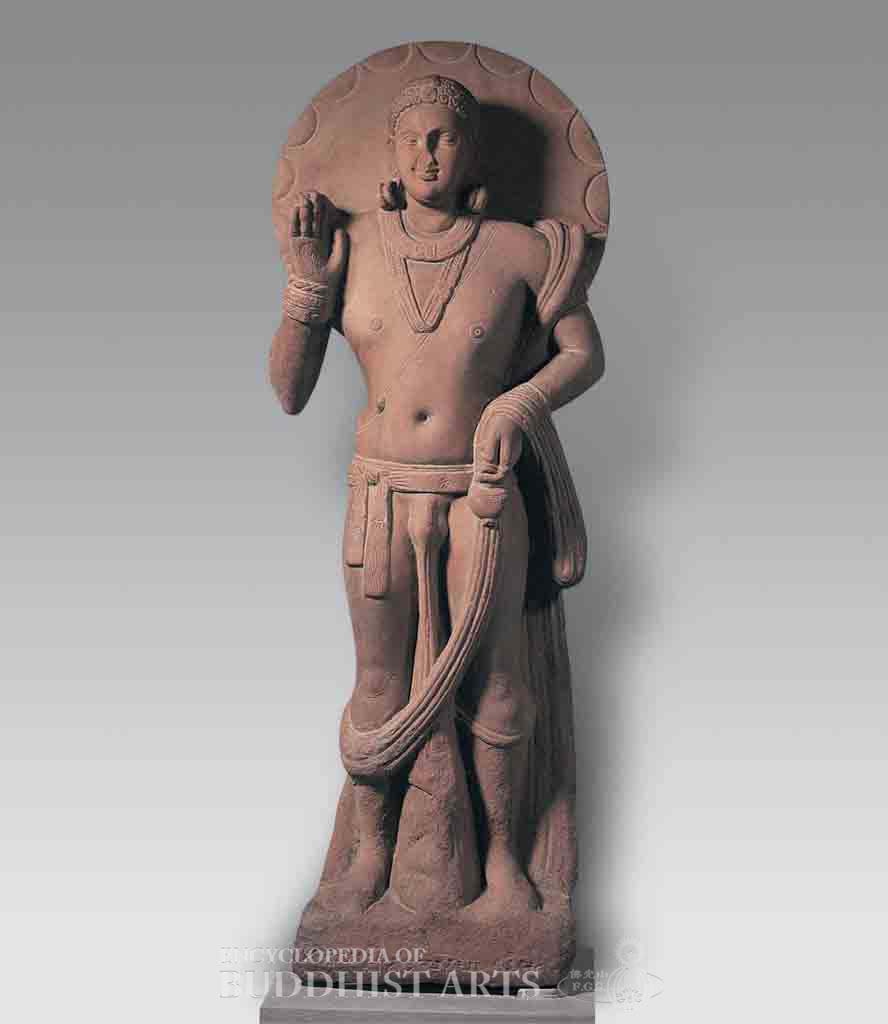
Ahichhatra: Maitreya Bodhisattva
Sandstone
Ahichhatra: Maitreya Bodhisattva
INDIA, Uttar Pradesh, Ahichhatra
The material used for this statue, as well as the treatment of the hair and nimbus, are characteristic of the Mathura style during the Kushan period (circa 1st–3rd century). This combination of elements leads experts to believe it was carved in the Mathura region and moved to Ahichhatra. The Bodhisattva’s hair is curled, in place of the turban this type of statue normally wears. The jewelry is bulky and the dhoti is diaphanous. The right hand is marked with a Dharma wheel and raised in the abhaya (fearlessness) mudra. The left hand holds a vase. A stole folds over the wrist. The nimbus behind the head is ringed with semicircles about the edge. The inscription engraved on the pedestal originally had two sentences, of which only the second remains to identify the statue as Maitreya Bodhisattva.
For more details, go to the Encyclopedia of Buddhist Arts: Sculpture A-F, page 3.
Cite this article:
author = Hsingyun and Youheng and Lovelock, Yann and Chou, Yuan and Huntington, Susan and Edson, Gary and Neather, Robert,
booktitle = {Encyclopedia of Buddhist Arts: Sculpture A-F},
pages = 3,
title = {{Ahichhatra: Maitreya Bodhisattva}},
volume = 10,
year = {2016}}