
Myoshinji Temple: Offering Instruments
Copper alloy
Myoshinji Temple: Offering Instruments
JAPAN, Kyoto; Edo period
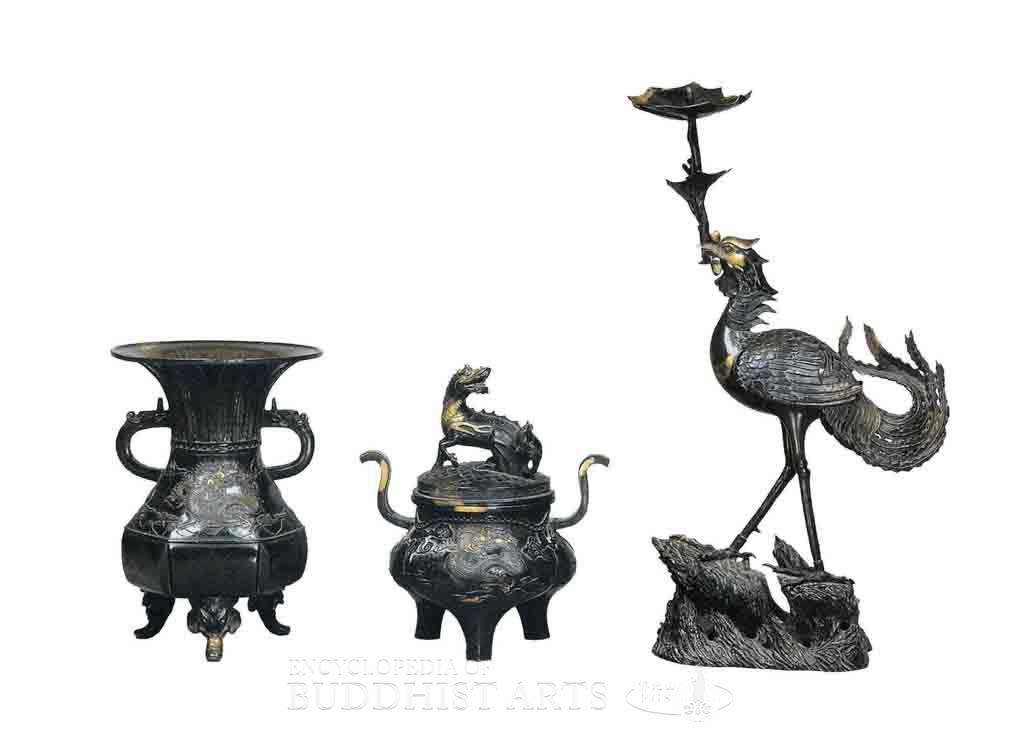
This set of three offering instruments includes a vase, incense burner, and candle holder. Such instruments originated in China and started to be used in Japan during the Kamakura period (1185–1333).
Standing on three legs, the vase is 33.3 cm high and has a hexagonal-shaped lower section. The middle section has a depiction of a rearing dragon, and the handles on either side are decorated with the faces of mythical creatures. The neck is quite high and culminates in a wide mouth.
The three-legged incense burner is 31.5 cm high. The lid features a mythical creature holding its head up high, and the squat body has a dragon and cloud patterns. There is a handle on either side. The 63.8 cm high candle holder has a phoenix which stands on a rock base holding a long stem in its mouth. At the top, there is a spike for holding a candle.
For more details, go to the Encyclopedia of Buddhist Arts: Artifacts, page 206.
Cite this article:
author = Hsingyun and Youheng and Youji and Pokorski, Stefanie and Mankuang and Fan, Wen,
booktitle = {Encyclopedia of Buddhist Arts: Artifacts },
pages = 206,
title = {{Myoshinji Temple: Offering Instruments}},
volume = 18,
year = {2016}}