
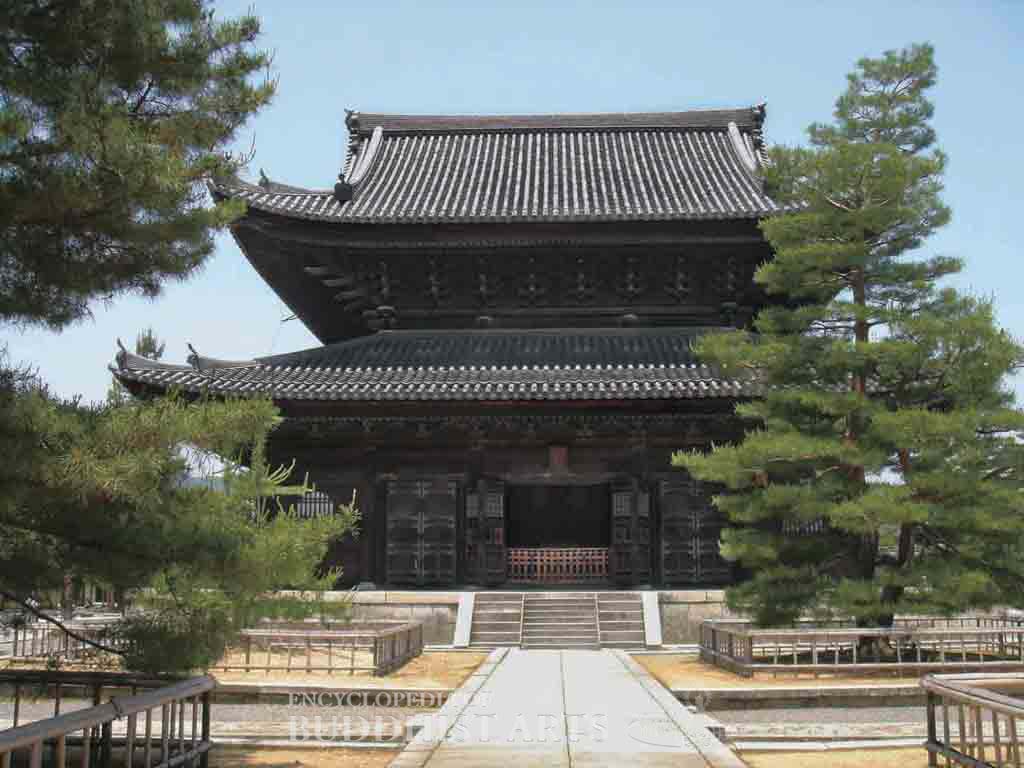
Myoshinji Temple: Buddha Hall
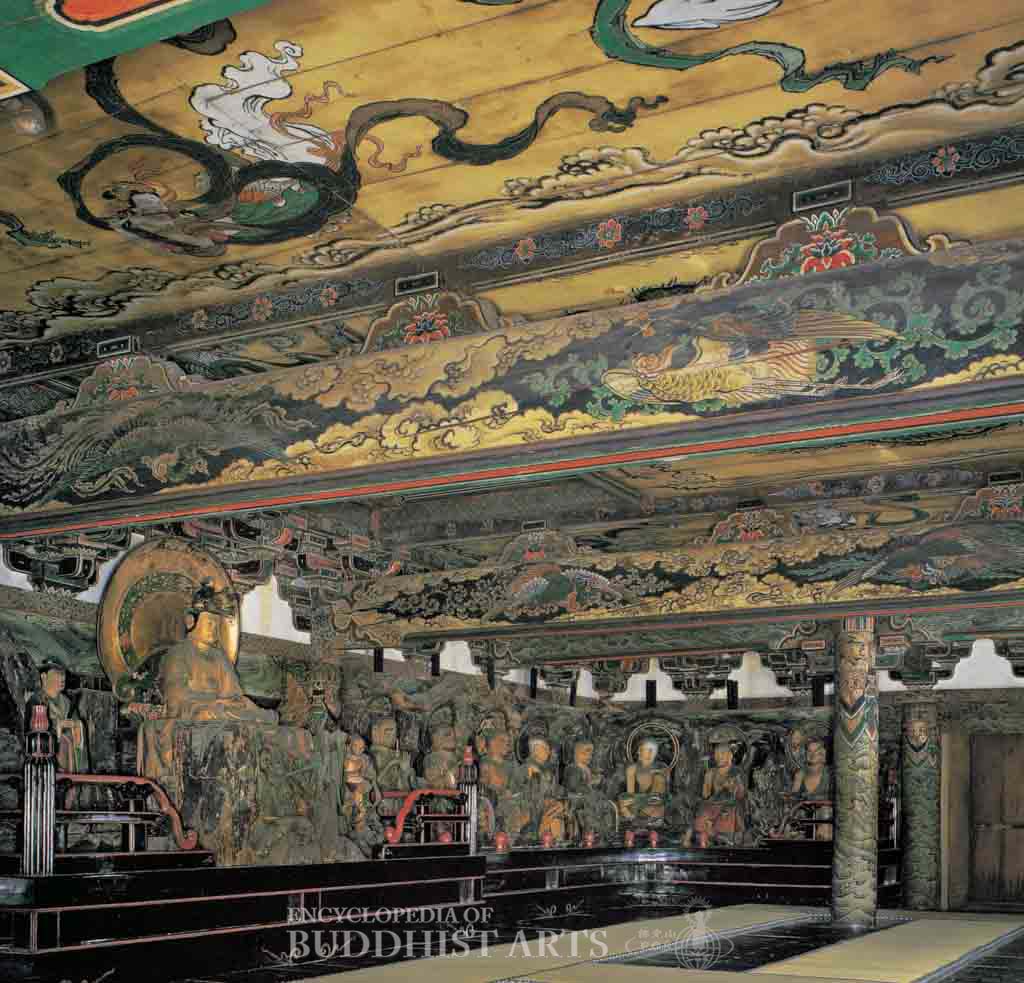
Myoshinji Temple: Main Temple Gate - Second Story (interior)
Myoshinji Temple
JAPAN, Kyoto
Myoshinji Temple is the head temple of the Rinzai school of Zen Buddhism. It was originally the residence of Kamakura Emperor Hanazono and was later adapted for use as a Zen monastery by Master Muso in 1377 during the Nanbokucho period. The temple declined and was reconstructed several times until it received patronage from Toyotomi Hideyoshi during the Edo period (1615–1868), and was finally restored. It is known as one of the most completely preserved temples in Japan, along with Daitokuji Temple. Most of the halls are modeled on Chinese Tang dynasty architecture and are from the Azuchi-Momoyama (1573–1615) and Edo periods.
The south-facing temple occupies an area of 43 ha. The main buildings on the south to north axis include the Imperial Messenger Gate, main temple gate, Buddha Hall, Dharma Hall, monastic quarters, and kuri. On either side there are the large abbot’s quarters, small abbot’s quarters, sutra repository, and founder’s hall. Most of the buildings have been listed as Important Cultural Properties.
The Buddha Hall was reconstructed in 1827 during the Edo period. The square hall measures 10.8 m on each side and has a double-eave hip-and-gable roof covered with cylindrical tiles. Statues of Sakyamuni Buddha flanked by Mahakasyapa and Ananda are enshrined within the hall. The five-by-four bay Dharma Hall, completed in 1656 during the Muromachi period, is the largest building in the temple. It has a double-eave hip-and-gable roof and is connected to the Buddha Hall by a walkway.
The two-story main temple gate was built in 1599 during the Azuchi-Momoyama period. It is 15.8 m high and has a hip-and-gable roof covered in cylindrical tiles. The first story is 15 m wide and 8.2 m deep, while the second story is 14.1 m wide and 7.4 m deep. The Sumeru throne within the gate is enshrined with Avalokitesvara, with the Sixteen Arhats statues along the sides. The inner columns, crescent beams, and ceiling are colorfully decorated. The kuri has an overhanging gable roof with a curved bargeboard. The roof is covered with cypress shingles. A statue of Skanda is enshrined within.
National Treasures held by the temple include calligraphy work by National Master Daito and a bronze bell. Among Important Cultural Properties there are paintings by Li Que and Ma Lin, and works by Kaiho Yusho.
For more details, go to the Encyclopedia of Buddhist Arts: Architecture M-S, page 763.
Cite this article:
author = Hsingyun and Youheng and Johnson, Peter and Mankuang and Lancaster, Lewis,
booktitle = {Encyclopedia of Buddhist Arts: Architecture M-S},
pages = 763,
title = {{Myoshinji Temple}},
volume = 3,
year = {2016}}