

Byodoin Temple: Phoenix Hall

Byodoin Temple: Walkway and Tower
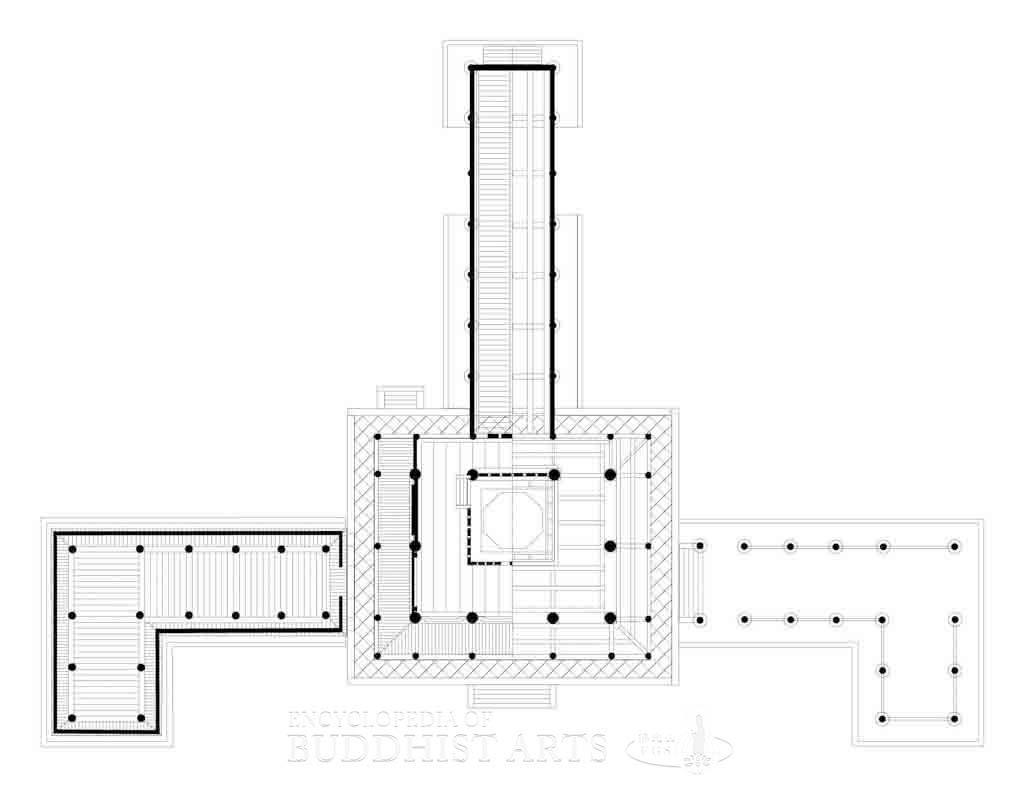
Byodoin Temple: Phoenix Hall (plan)
Byodoin Temple
JAPAN, Kyoto, Uji
The temple was converted from a rural villa by Fujiwara no Yorimichi. The villa was originally built in 889 during the Heian period by Minamoto no Toru. In 1052, the main hall was built and the temple was named Byodoin. In order to promote the Pure Land school, a number of other buildings were constructed. As part of the Historic Monuments of Ancient Kyoto, it was listed as a UNESCO World Heritage Site in 1994.
The existing halls include the Phoenix Hall and Avalokitesvara Hall, listed in 1951 as a National Treasure and an Important Cultural Property respectively.
The Phoenix Hall is 46.9 m wide and 35.4 m deep. It consists of a central hall flanked by covered walkways with shorter extensions forming an L-shape. The three-by-two bay central hall has a double-eave hip-and-gable roof covered in cylindrical tiles. There are gilt bronze phoenixes at either end of the central ridge. The extensions to the walkway have a single-eave overhanging gable roof. There are towers with double-eave pyramidal roofs where the walkways meet the shorter extensions. The walkways and the towers have low balustrades and roofs covered in cylindrical tiles. The central hall houses items such as paintings, sculptures, and artifacts, which show the very best of Heian period (794–1185) aristocratic culture. In the middle of the hall there is a seated statue of Amitabha Buddha, which is the only authentic example of the work of the sculptor Jocho. The canopy above the statue is considered to be the most magnificent work of art of its type. The high central doorway allows the statue of Amitabha Buddha to be visible from the outside. Among the 14 panel paintings, there are Nine Grades of Rebirth into the Western Pure Land and the Contemplation of the Sun. The columns are painted with apsaras, while the surrounding walls have depictions of 51 Bodhisattvas making offerings among the clouds. The overall impression is that of having entered the Pure Land.
The temple houses one of the three famous bells. The garden, designed with the concept of the Pure Land in mind, is listed as a National Historical Site.
For more details, go to the Encyclopedia of Buddhist Arts: Architecture A-F, page 117.
Cite this article:
author = Hsingyun and Youheng and Johnson, Peter and Mankuang and Lancaster, Lewis,
booktitle = {Encyclopedia of Buddhist Arts: Architecture A-F},
pages = 117,
title = {{Byodoin Temple}},
volume = 1,
year = {2016}}