
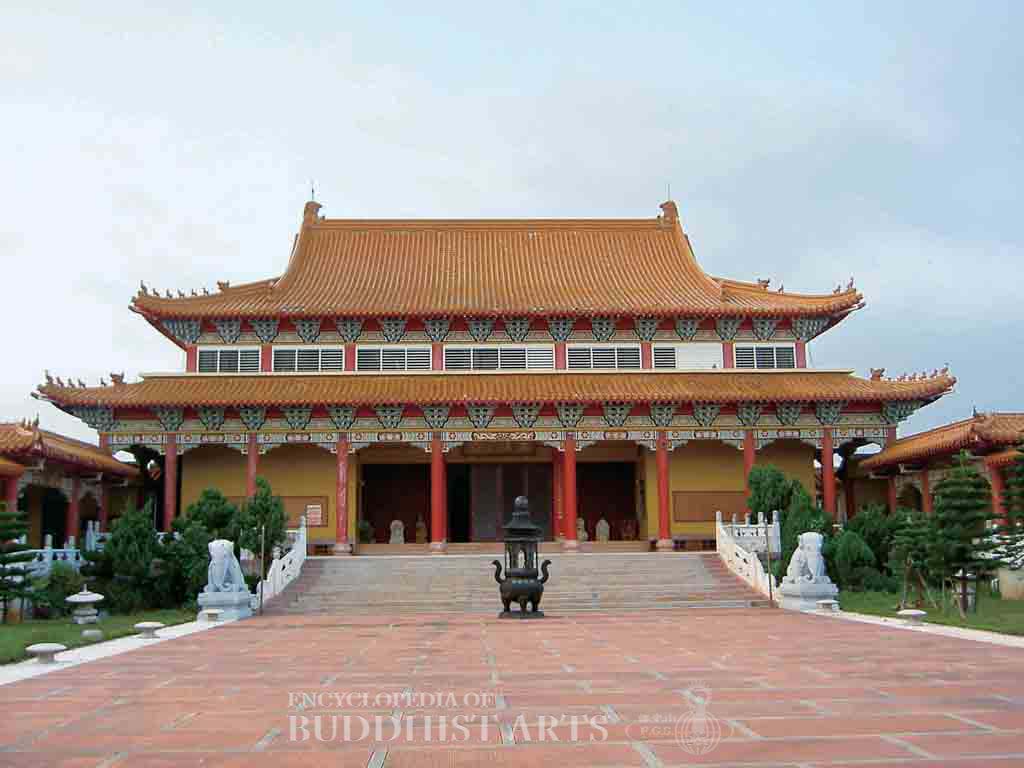
Fo Guang Shan Hai Tian Temple: Great Hero Hall
Fo Guang Shan Hai Tian Temple
TAIWAN, Penghu
Hai Tian means Sea and Sky. The temple is situated in Magong, behind the hills of Dongwei. It is the largest temple on Penghu and is a branch temple of Fo Guang Shan. The founder of Fo Guang Shan, Master Hsing Yun, saw the possibility of developing Buddhism in the area during his visit in 1976, and the temple was constructed in 1983.
The temple occupies 2.4 ha, of which 8,700 sq m are taken up by buildings. The buildings include the main temple gate, Hall of the Four Heavenly Kings, Great Hero Hall, and Great Compassion Hall. The five-bay wide Great Hero Hall has a double-eave hip-and-gable roof covered in yellow glazed tiles. The Five Dhyani Buddhas are enshrined in the hall. The walls are lined with numerous Buddha niches of various sizes, each of which contains a Buddha image. The Great Compassion Hall houses a statue of the Thousand-Armed, Thousand-Eyed Avalokitesvara Bodhisattva. The wall behind the main statue is filled with relief carvings of the Thirty-Three Manifestations of Avalokitesvara, as well as the illustration of the Great Compassion Dharani Sutra.
For more details, go to the Encyclopedia of Buddhist Arts: Architecture A-F, page 316.
Cite this article:
author = Hsingyun and Youheng and Johnson, Peter and Mankuang and Lancaster, Lewis,
booktitle = {Encyclopedia of Buddhist Arts: Architecture A-F},
pages = 316,
title = {{Fo Guang Shan Hai Tian Temple}},
volume = 1,
year = {2016}}