
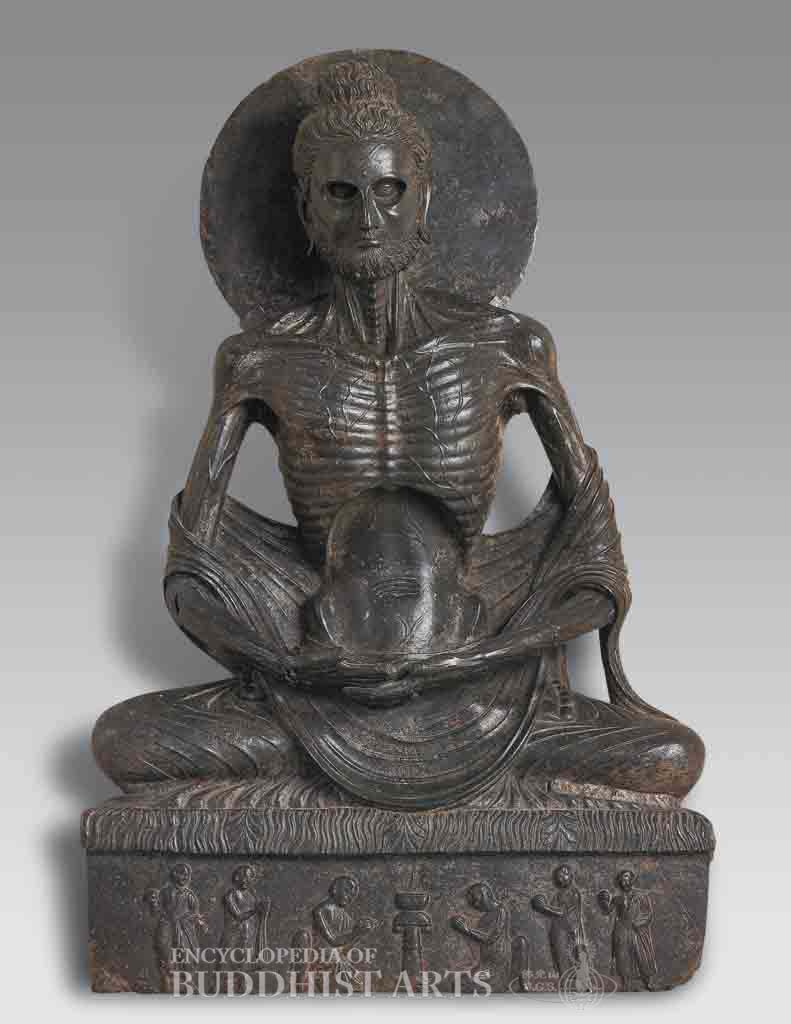
Sikri: Ascetic Sakyamuni
Schist
Sikri: Ascetic Sakyamuni
PAKISTAN, Balochistan, Sikri; Kushan period
The sculpture is of the future Sakyamuni Buddha as an ascetic seated on a grass mat in full lotus position with hands joined in dhyana (meditation) mudra. During one period of his religious pursuit, Sakyamuni underwent severe austerities, including near starvation. The eyes of the figure are sunken in the haggard and bearded face. The flesh has wasted away from the body, exposing the bones and tendons that protrude through the skin. The robe has slipped from the shoulders and is supported by the arms, so that its raised folds draw attention to the pattern of the ribs. When the statue was first discovered in Sikri in 1880, it shocked all those present because the portrayal was so different from the usual, calm image of the Buddha. It represents the ultimate in iron will and determination in pursuit of enlightenment, however “ignoble, and profitless” he later acknowledged the practice of mortification in his first teaching.
For more details, go to the Encyclopedia of Buddhist Arts: Sculpture N-Sr, page 1091.
Cite this article:
author = Hsingyun and Youheng and Lovelock, Yann and Chou, Yuan and Huntington, Susan and Edson, Gary and Neather, Robert,
booktitle = {Encyclopedia of Buddhist Arts: Sculpture N-Sr},
pages = 1091,
title = {{Sikri: Ascetic Sakyamuni}},
volume = 12,
year = {2016}}