
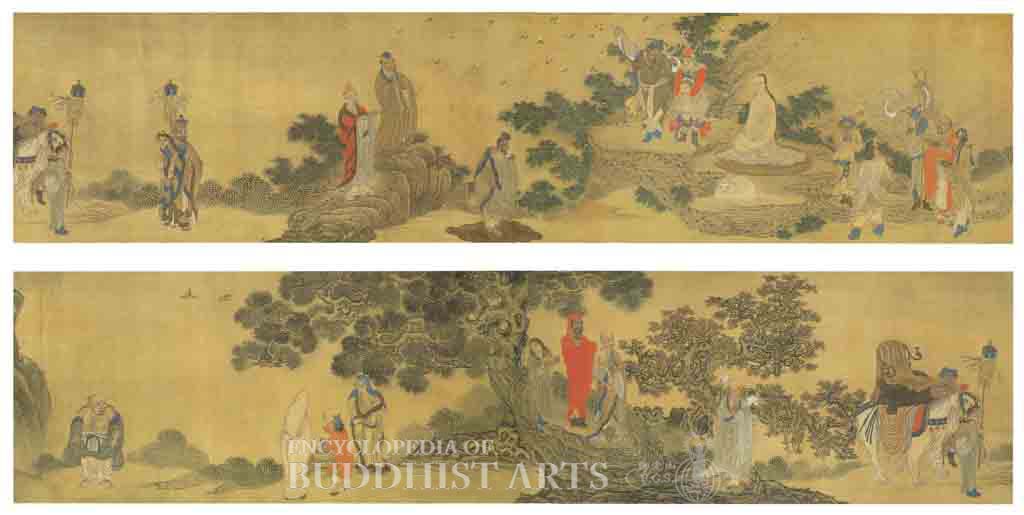
Arhats by Wu Bin (detail); Ming dynasty
Color on silk
Wu Bin
CHINA, Fujian, Putian; Ming dynasty
Wu Bin was a painter who was born in Putian, Fujian, but later moved to Jinling (present day Nanjing). Wu was highly regarded by both the government and the public for his unique painting skills. He was appointed as secretary and court painter by Emperor Wanli (reigned 1573–1620) of the Ming dynasty.
Wu specialized in painting Buddhist figures and imagery; he also painted landscapes and carved his own seals. He often visited Qixia Temple in Jiangsu, where he painted Five Hundred Arhats. His depictions of arhats have eccentric appearances and are painted in vivid colors with delicate brushstrokes that create a three-dimensional effect. His precise, creative paintings were a departure from the prevailing style of his time, which was heavily influenced by the art of the Tang (618–907) and Song (960–1279) dynasties.
His extensive collection of works include Samantabhadra Bodhisattva Meeting a Monk, kept at the Palace Museum in Beijing; Twenty-five Kinds of Perfect Understanding from the Surangama Sutra and Avalokitesvara Bodhisattva, kept at the National Palace Museum in Taipei, Taiwan; and Sixteen Arhats in the Metropolitan Museum of Art in New York, USA.
For more details, go to the Encyclopedia of Buddhist Arts: People, page 294.
Cite this article:
author = Hsingyun and Youheng and Youlu and Pokorski, Stefanie and Yichao and Mankuang and Miaohsi,
booktitle = {Encyclopedia of Buddhist Arts: People },
pages = 294,
title = {{Wu Bin}},
volume = 19,
year = {2016}}