
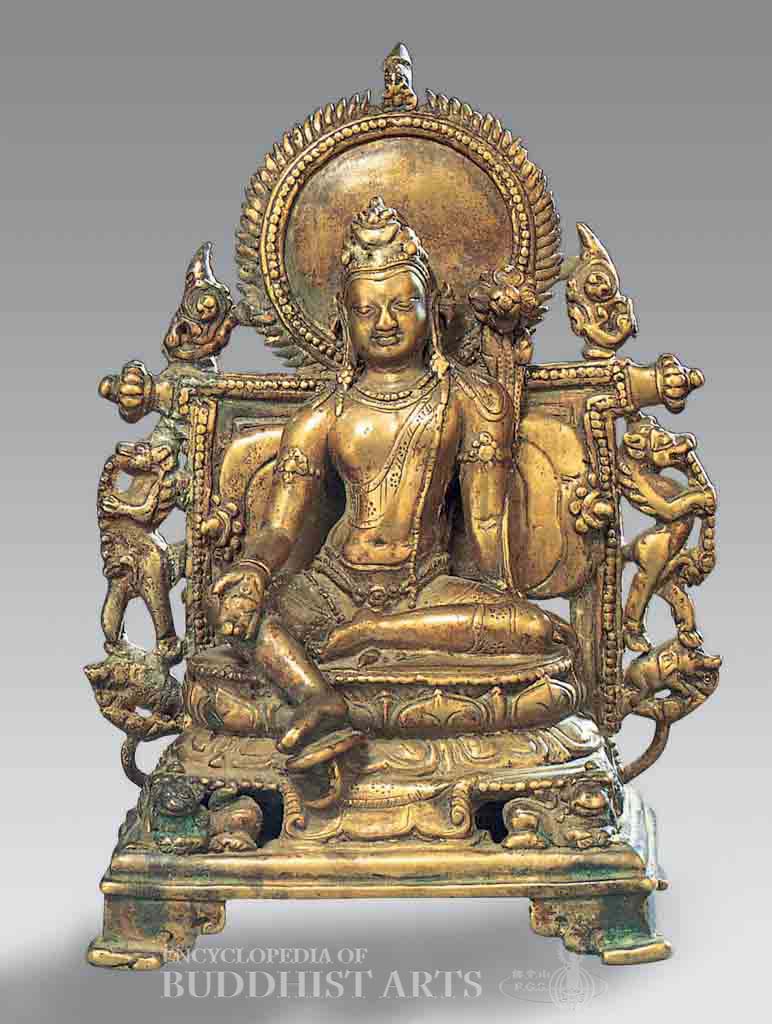
Kurkihar: Seated Bodhisattva
Bronze
Kurkihar: Seated Bodhisattva
INDIA, Bihar, Kurkihar; Pala period
The statue was discovered at Kurkihar and the style is similar to those found at nearby Nalanda. However, from the 9th century onwards, the Kurkihar bronzes started to develop their own individual style, including tall pointed crowns, nimbuses edged with flames, and silver or copper inlays.
The edge of the nimbus is beaded and topped with an ornament. The Bodhisattva wears a headdress, some jewelry, a decorated stole and a sacred thread. The skirt is fastened with a belt with a floral clasp. The right hand is open in varada (wish-granting) mudra while the left supports the weight of the body and at the same time grasps the long stem of a lotus that rises behind the shoulder. The figure sits in the relaxation posture with the head to one side, the right foot hanging over the throne to rest on a lotus outgrowth.
The throne has a double lotus seat supported at the corners by crouching lions. The back-rest is ornamented on either side with a lion on its hind legs standing on a boar that is in turn supported by a lotus. Above the beaded throne are conches that connect with the nimbus. The donor’s surname is inscribed on one of these objects.
For more details, go to the Encyclopedia of Buddhist Arts: Sculpture G-M, page 574.
Cite this article:
author = Hsingyun and Youheng and Lovelock, Yann and Chou, Yuan and Huntington, Susan and Edson, Gary and Neather, Robert,
booktitle = {Encyclopedia of Buddhist Arts: Sculpture G-M},
pages = 574,
title = {{Kurkihar: Seated Bodhisattva}},
volume = 11,
year = {2016}}