
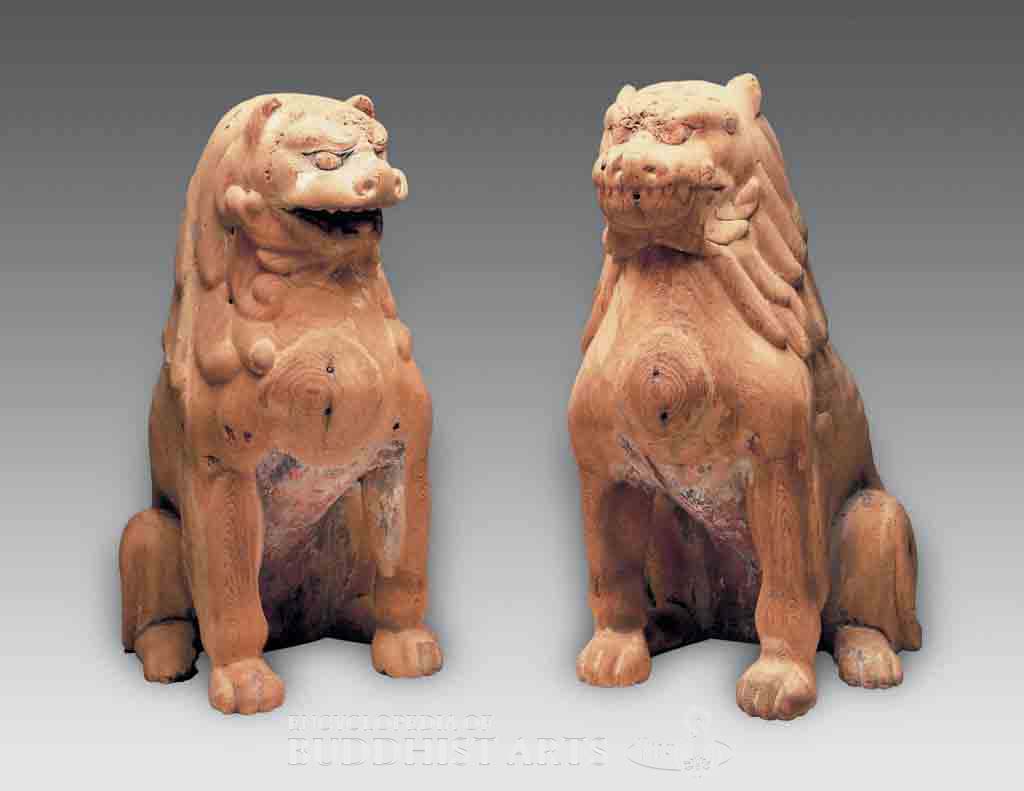
Lions as Dharma Protectors
Cypress wood
Lions as Dharma Protectors
JAPAN; Kamakura period
These cedar wood lions date from the 13th century and still bear a vestige of pigment from that era. Considered as the symbol of fearlessness in Buddhism, they entered Japan with the faith as protective figures and were especially popular during the Kamakura period (1185–1333).
For more details, go to the Encyclopedia of Buddhist Arts: Sculpture G-M, page 609.
Cite this article:
Hsingyun, et al. "Lions as Dharma Protectors." Encyclopedia of Buddhist Arts: Sculpture G-M, vol. 11, 2016, pp. 609.
Hsingyun, Youheng, Yann Lovelock, Yuan Chou, Susan Huntington, Gary Edson, and Robert Neather. 2016. "Lions as Dharma Protectors" In Encyclopedia of Buddhist Arts: Sculpture G-M, 11:609.
Hsingyun, Youheng, Lovelock, Y., Chou, Y., Huntington, S., Edson, G., & Neather, R.. (2016). Lions as Dharma Protectors. In Encyclopedia of Buddhist Arts: Sculpture G-M (Vol. 11, pp. 609).
@misc{Hsingyun2016,
author = Hsingyun and Youheng and Lovelock, Yann and Chou, Yuan and Huntington, Susan and Edson, Gary and Neather, Robert,
booktitle = {Encyclopedia of Buddhist Arts: Sculpture G-M},
pages = 609,
title = {{Lions as Dharma Protectors}},
volume = 11,
year = {2016}}
author = Hsingyun and Youheng and Lovelock, Yann and Chou, Yuan and Huntington, Susan and Edson, Gary and Neather, Robert,
booktitle = {Encyclopedia of Buddhist Arts: Sculpture G-M},
pages = 609,
title = {{Lions as Dharma Protectors}},
volume = 11,
year = {2016}}