
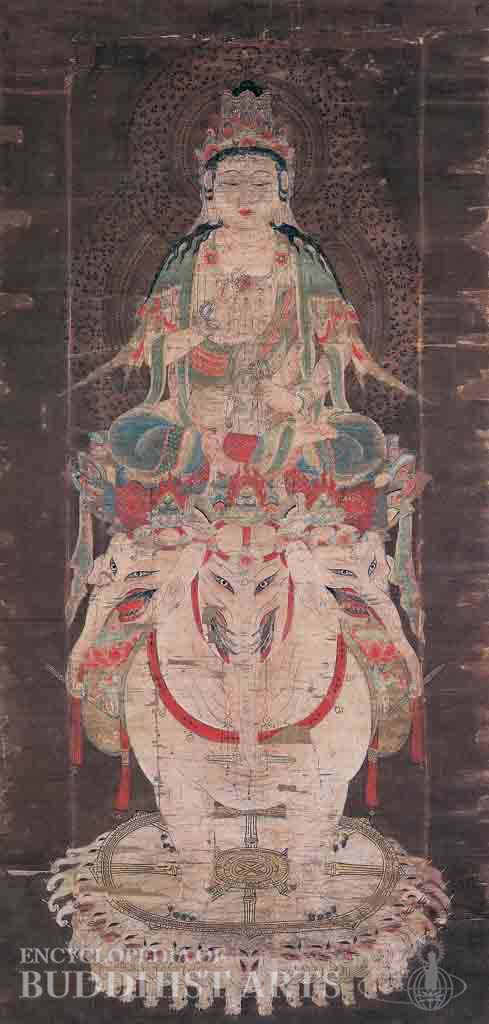
Matsuoji Temple: Samantabhadra Bodhisattva
Ink and color on silk
Matsuoji Temple: Samantabhadra Bodhisattva
JAPAN, Kyoto; Heian period
In Tendai school of Japanese Buddhism, Samantabhadra Bodhisattva is said to grant health and longevity to devotees. This 12th century painting, based on descriptions in the Sutra on Samantabhadra’s Dharani for Prolonging Life, is the oldest known Japanese depiction of Samantabhadra Bodhisattva with two arms. It was listed as a National Treasure in 1952.
In the picture, Samantabhadra appears youthful and has a peaceful expression on his round face. The Bodhisattva wears a crown decorated with tiny images of the Five Dhyani Buddhas. Long black hair hangs down over the shoulders. The Bodhisattva holds a vajra in the right hand and a bell in the left hand. Both the nimbus and the aureole are depicted using fine fragments of silver foil.
Samantabhadra sits in full lotus position on a lotus throne carried by a three-headed, six-tusked white elephant that stands on a wheel supported by a circle of small elephants. Each head of the elephant has a snarling, open mouth, and each of the three trunks hold a vajra. The beast has a sturdy body, piercing eyes, and a fierce expression, contrasting with the serene appearance of the Bodhisattva. Both are painted bright white and stand out brilliantly from the dark background. The use of white color could have been influenced by Chinese Song dynasty style paintings.
For more details, go to the Encyclopedia of Buddhist Arts: Painting I-O, page 523.
Cite this article:
author = Hsingyun and Youheng and Youlu and Wilson, Graham and Manho and Mankuang and Huntington, Susan,
booktitle = {Encyclopedia of Buddhist Arts: Painting I-O},
pages = 523,
title = {{Matsuoji Temple: Samantabhadra Bodhisattva}},
volume = 15,
year = {2016}}