
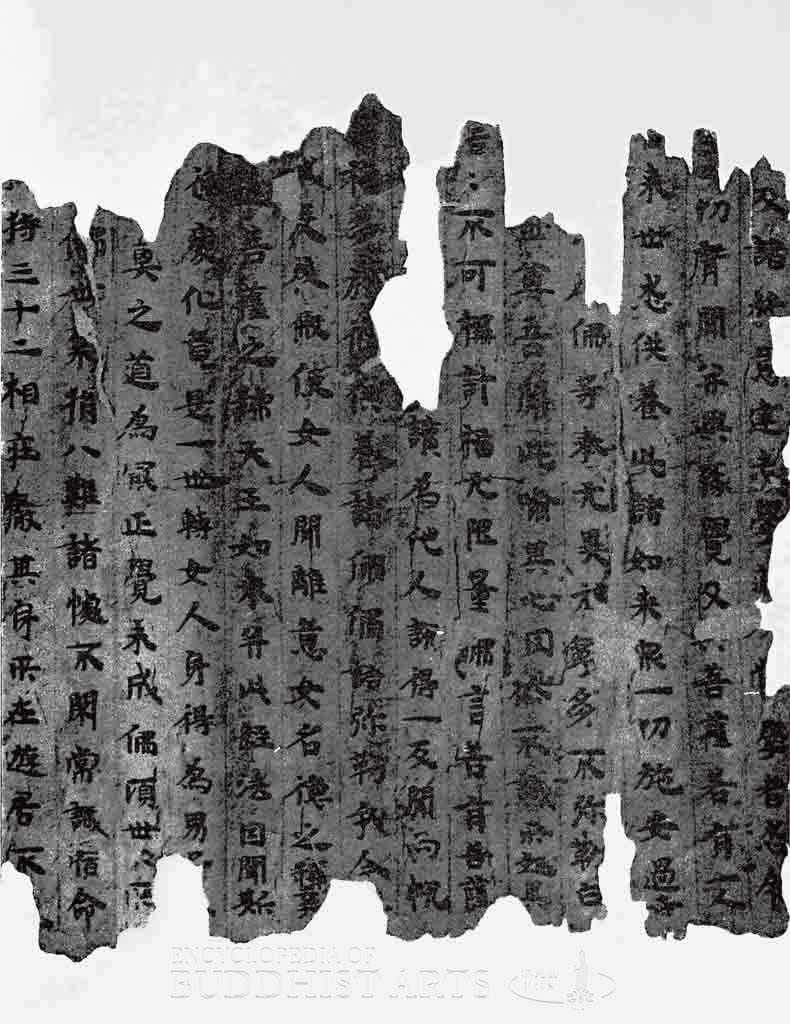
Tuyoq Caves: Buddha Samgiti Sutra (fragment)
Ink on paper
Tuyoq Caves: Buddha Samgiti Sutra
CHINA, Xinjiang, Turpan; Western Jin dynasty
This sutra manuscript was discovered in 1912 by the Japanese Otani expedition of the Tuyoq Caves in Turpan. It was inscribed in 296, which makes it the earliest hand-copied and dated Buddhist sutra. This unearthed artifact provides an invaluable source of study on the transformations in styles and techniques of calligraphy during the Western Jin dynasty (265–316). The scriptural fragment shown was documented in the Illustrated Catalog of the Archaeology of Central Asia, but its whereabouts is unknown. An early 21st century collaborative study between the Lushun Museum of Liaoning and Ryukoku University of Japan of the museum’s collection found a similar fragment of the Buddha Samgiti Sutra—a Buddhist sutra hand-copied in Chinese characters—that originated from the Central Asia. This fragmented artifact was verified to be from the same sutra copy as the one documented in the catalog.
The Buddha Samgiti Sutra narrates the three months in which the Buddha was in meditation in Rajagriha. The Buddha visited the abode of the Buddha of the Heavenly World of Universal Light, and expounded the essence of the sutras including the emptiness of all phenomena, the six paramitas, and the vows of an aspiring Bodhisattva.
Western Jin stele inscriptions predominantly consisted of clerical script, much like the Han and Wei dynasties. Inscriptions on bamboo or wooden slips, sheet fragments, and scrolls reveal a variety of styles including clerical, running, as well as cursive scripts. There were also regular scripts with a strong clerical tendency. A strict character structure is identified in this work. The “na” (right-falling) horizontal strokes are strong and resemble movements employed in clerical calligraphy, while the entry of horizontal strokes are typically sharp-pointed due to the speedy pace of writing. Each character is emphasized with greater brush pressure on its ending stroke, which is an important feature of sutra copy texts. The work is an important example of the gradual transition of scripting styles from clerical to regular, which occurred during the Western Jin dynasty (265–316).
For more details, go to the Encyclopedia of Buddhist Arts: Calligraphy, page 262.
Cite this article:
author = Hsingyun and Youheng and Youlu and Pokorski, Stefanie and Mankuang and Edson, Gary,
booktitle = {Encyclopedia of Buddhist Arts: Calligraphy },
pages = 262,
title = {{Tuyoq Caves: Buddha Samgiti Sutra}},
volume = 17,
year = {2016}}