
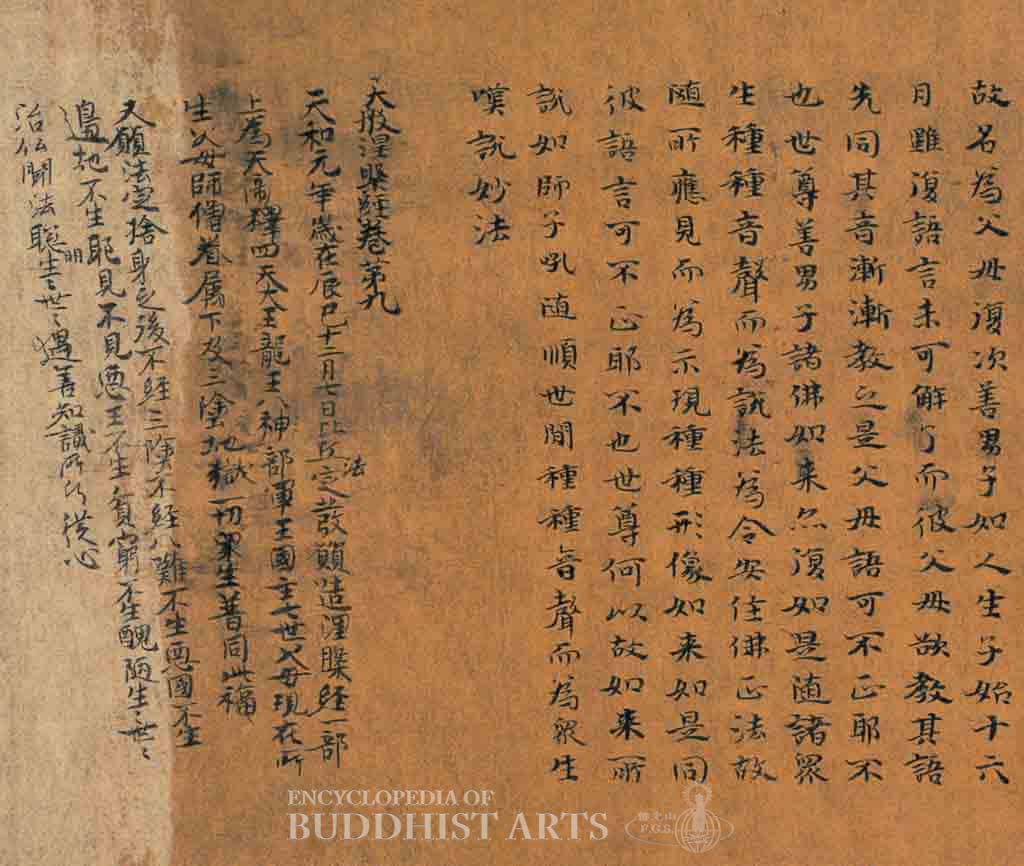
Mogao Cave 17: Mahaparinirvana Sutra - Fascicle 9 (right end section)
Ink on paper
Mogao Cave 17: Mahaparinirvana Sutra - Fascicle 9
CHINA, Gansu, Dunhuang; Northern Zhou dynasty
Discovered in Mogao Cave 17 in Dunhuang, this fascicle was scripted with a colophon at the end stating it was produced in 566 by monk Fading. The manuscript dates to the Northern Zhou dynasty (557–581), but the calligrapher is unknown. The discovery is extremely rare as it survived the persecution of Buddhism in 573 that was ordered by Emperor Wu (reigned 560–578) of the Northern Zhou dynasty and destroyed numerous Buddhist artifacts, especially paper manuscripts. The Mahaparinirvana Sutra expounds the notion that every sentient being has innate Buddha nature. It maintains that the Buddha provides assurance on the path to liberation.
As a calligraphic work from the Northern Dynasties (386–581), the manuscript is atypically endowed with a tidy yet elegant writing style. It is markedly different from the rustic and vigorous strokes found in the inscriptions of Northern steles. The brushwork is well-rounded, and strokes are fluently executed with a noticeable indication of running script. The right-falling “na” strokes terminate with upswept finishes that are reminiscent of clerical style. There is a sense of stability manifested in the piece with characters that are well-balanced in composition.
For more details, go to the Encyclopedia of Buddhist Arts: Calligraphy, page 162.
Cite this article:
author = Hsingyun and Youheng and Youlu and Pokorski, Stefanie and Mankuang and Edson, Gary,
booktitle = {Encyclopedia of Buddhist Arts: Calligraphy },
pages = 162,
title = {{Mogao Cave 17: Mahaparinirvana Sutra - Fascicle 9}},
volume = 17,
year = {2016}}