
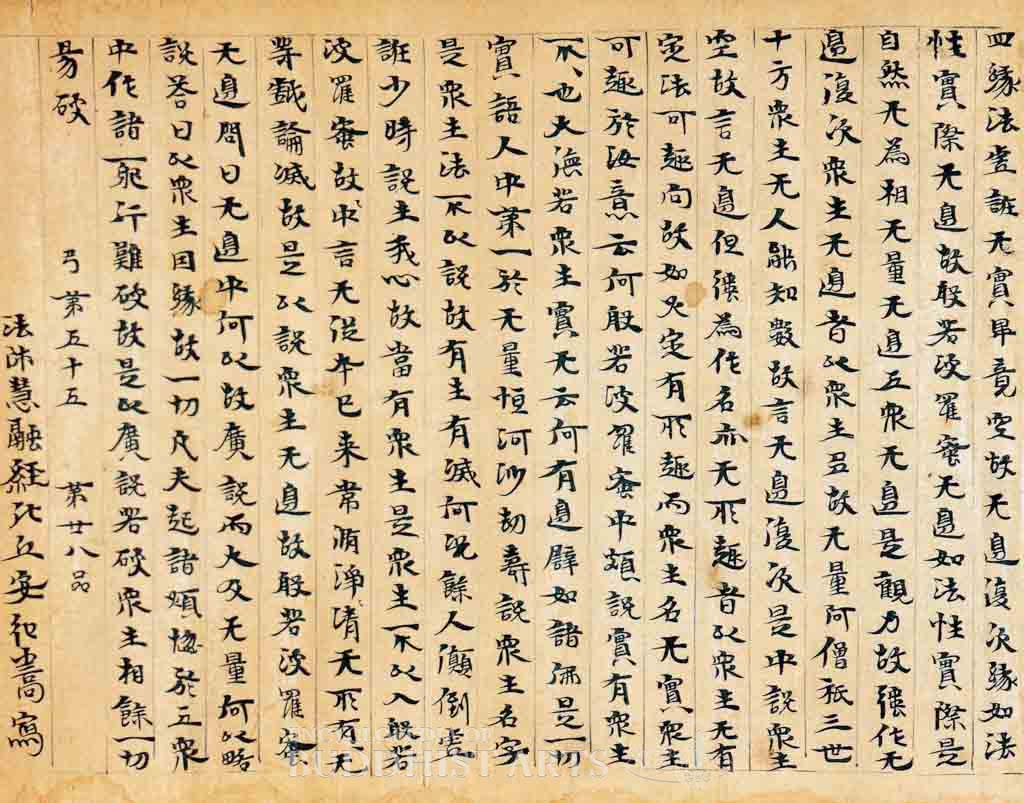
Sutra Manuscript (detail)
Ink on paper
Sutra Manuscript
CHINA; Eastern Jin dynasty
The header portion of the original scroll is missing, which leaves this manuscript with only eight joined sheets. Each sheet contains 28 lines, and each line has an average of 19 characters. The colophon at the end indicates the text as the 28th chapter of the Fascicle 55, transcribed by monk Huirong.” Although not dated, the calligraphic style and format of scroll suggest that it came from the Eastern Jin dynasty (317–420).
The Wei, Jin, and Six Dynasties (220–589) periods represent a phase of substantial maturation in the development of various calligraphic scripts in China. Each character in this sutra scroll was first inked with the brush applied in side tip, instead of vertically, which results in a precise start to the stroke. The continuous and simplified strokes hint of a running script. “Pie” (left-falling) diagonal strokes were articulated with sharp, pointed endings, while “na” (right-falling) diagonal strokes were finished in a wave-like manner. These characteristics, heavily reminiscent of the preceding clerical script, denote this manuscript as a work of transition between clerical and running script styles. Other features include a rich use of black ink, a steady script written in swift and energetic brushwork, and a natural, fluent flow in the composition.
For more details, go to the Encyclopedia of Buddhist Arts: Calligraphy, page 244.
Cite this article:
author = Hsingyun and Youheng and Youlu and Pokorski, Stefanie and Mankuang and Edson, Gary,
booktitle = {Encyclopedia of Buddhist Arts: Calligraphy },
pages = 244,
title = {{Sutra Manuscript}},
volume = 17,
year = {2016}}