
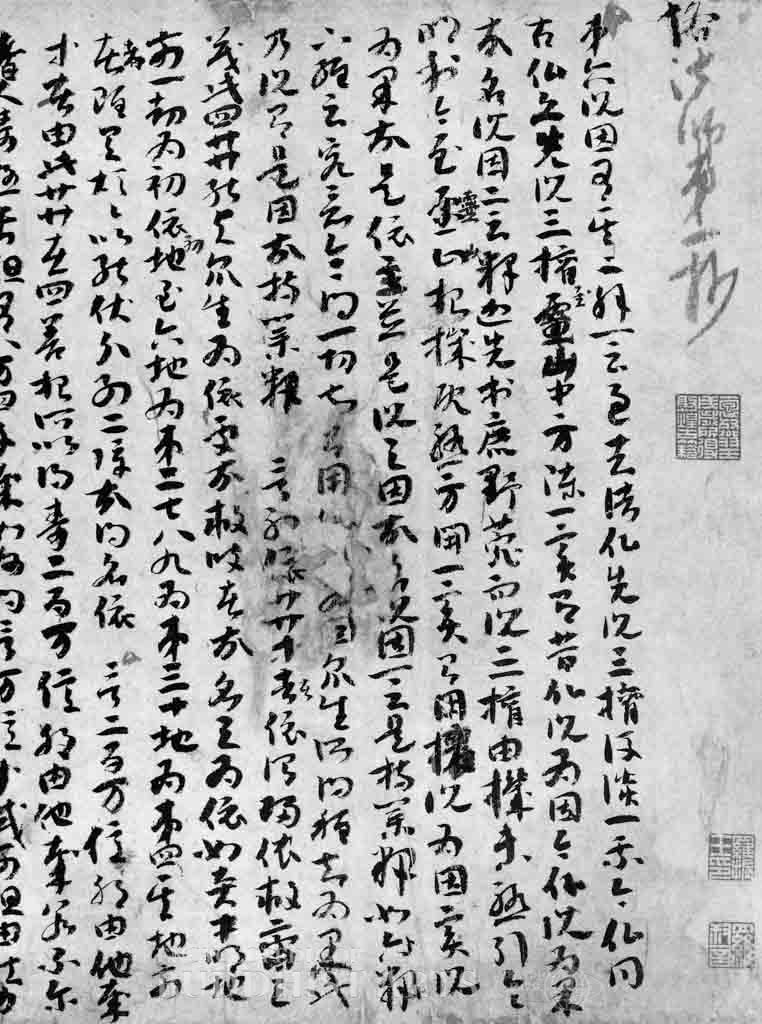
Mogao Cave 17: Master Ke’s First Copy
Ink on paper
Mogao Cave 17: Master Ke’s First Copy
CHINA, Gansu, Dunhuang; Tang dynasty
This manuscript, discovered in Mogao Cave 17 in Dunhuang, was transcribed by a monk known as Master Ke, as evinced by a notation at the beginning that reads, “First Copy by Master Ke.”
As Buddhism flourished during the Tang dynasty (618–907), there was an accompanying increase in manuscript copying. This surge was also an extension of the mind-cultivating influence that calligraphy had on the public. Most manuscripts during this time were copied by common people, with a uniform calligraphic style that contrasted with the distinctive styles of renowned calligraphers. This piece can be dated to the Early Tang period (618–712) based on the calligraphic style used. The overall work is naturally fluent, and the scripting is reminiscent of the cursive style used by Wang Xizhi and Wang Xianzhi.
For more details, go to the Encyclopedia of Buddhist Arts: Calligraphy, page 164.
Cite this article:
author = Hsingyun and Youheng and Youlu and Pokorski, Stefanie and Mankuang and Edson, Gary,
booktitle = {Encyclopedia of Buddhist Arts: Calligraphy },
pages = 164,
title = {{Mogao Cave 17: Master Ke’s First Copy}},
volume = 17,
year = {2016}}